
Muscle Memory Explained: How Quickly Can You Regain Lost Muscle?
Muscle Memory Explained: How to Regain Lost Muscle Faster Than You Think
Muscle Memory Definition
Muscle memory is the body’s ability to relearn physical skills or regain previously developed strength and muscle faster than it took to build them initially.
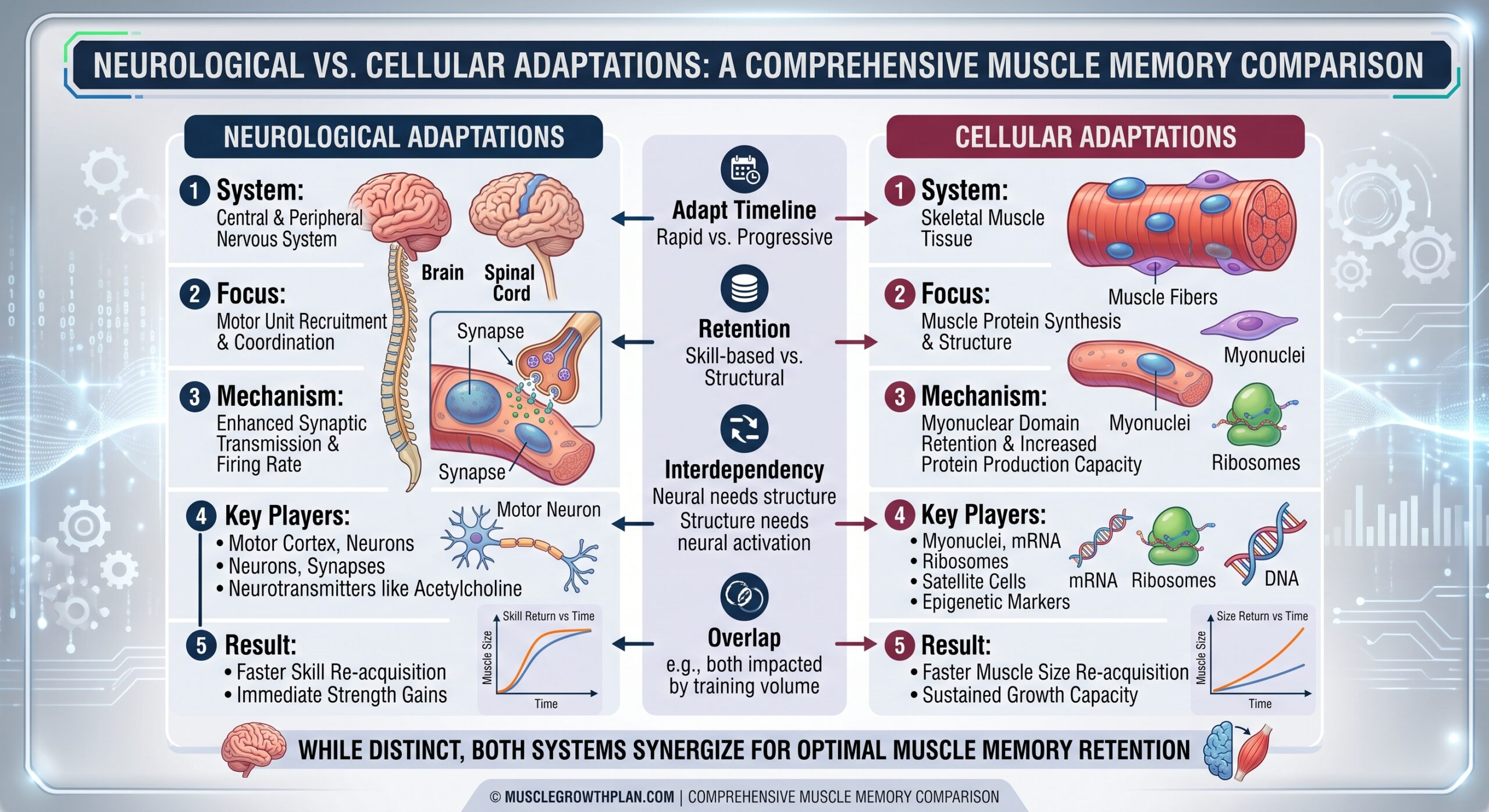
The term describes two related—but different—phenomena:
- Neurological muscle memory: Your nervous system remembers practiced movements and exercise techniques.
- Cellular muscle memory: Previously trained muscle may retain biological adaptations that help it respond more efficiently when training resumes.
This is why someone returning to lifting after several months away may rebuild strength and size faster than a complete beginner starting from the same visible condition.
Simple definition
Muscle memory is the retained effect of previous training that can help you recover lost skill, strength, and muscle more quickly after a break.
Is Muscle Memory Real?
Yes, although the exact biological mechanisms are still being studied.
Research supports the idea that previously trained people can regain performance relatively quickly during retraining. Studies of detraining and retraining have shown that lost strength can return after training resumes, sometimes within a shorter period than the original training phase. One source National Institutes of Health
Researchers are investigating several possible explanations:
- Retained motor skills
- Nervous-system adaptations
- Myonuclei added during earlier growth
- Epigenetic changes inside muscle cells
- Persistent changes in muscle proteins
- Faster relearning of training habits and technique
Recent reviews describe muscle memory as a combination of cellular and epigenetic mechanisms rather than one single process.
The Two Types of Muscle Memory
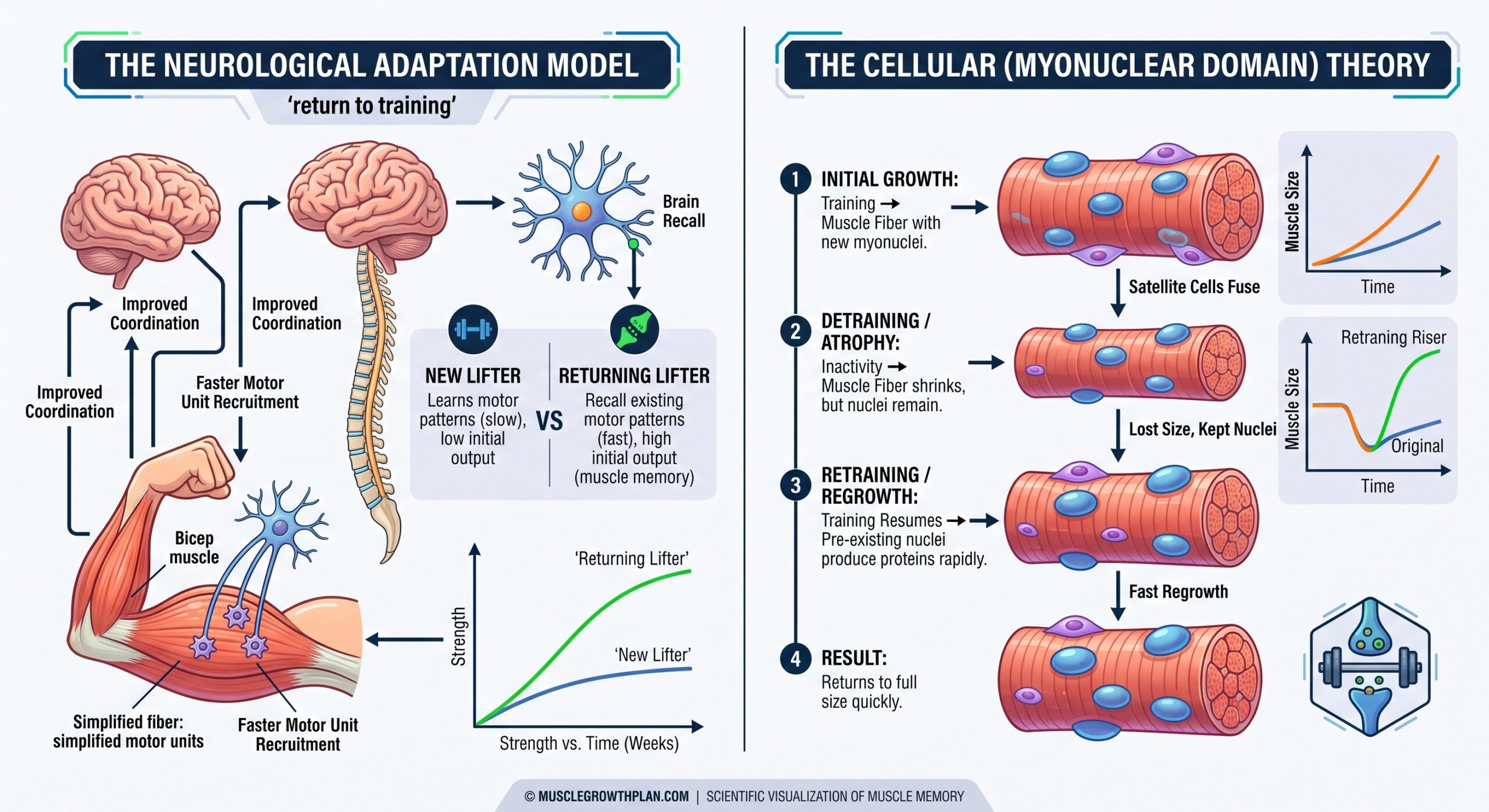
1. Neurological Muscle Memory
When you repeatedly perform an exercise, your brain and nervous system become more efficient at coordinating it.
You improve:
- Motor-unit recruitment
- Movement timing
- Balance
- Exercise technique
- Coordination between muscles
- Confidence under load
This is why a returning lifter may quickly regain strength even before visibly rebuilding all lost muscle.
Strength is not determined by muscle size alone. It also depends on how effectively your nervous system can recruit and coordinate the available muscle.
One detraining and retraining study in older men found that strength returned to previously trained levels after eight weeks of retraining. The researchers suggested that retained and rapidly reacquired neural adaptations contributed substantially to the return of strength.
2. Cellular Muscle Memory
Cellular muscle memory refers to lasting changes within skeletal muscle that may remain after the muscle becomes smaller.
Possible mechanisms include:
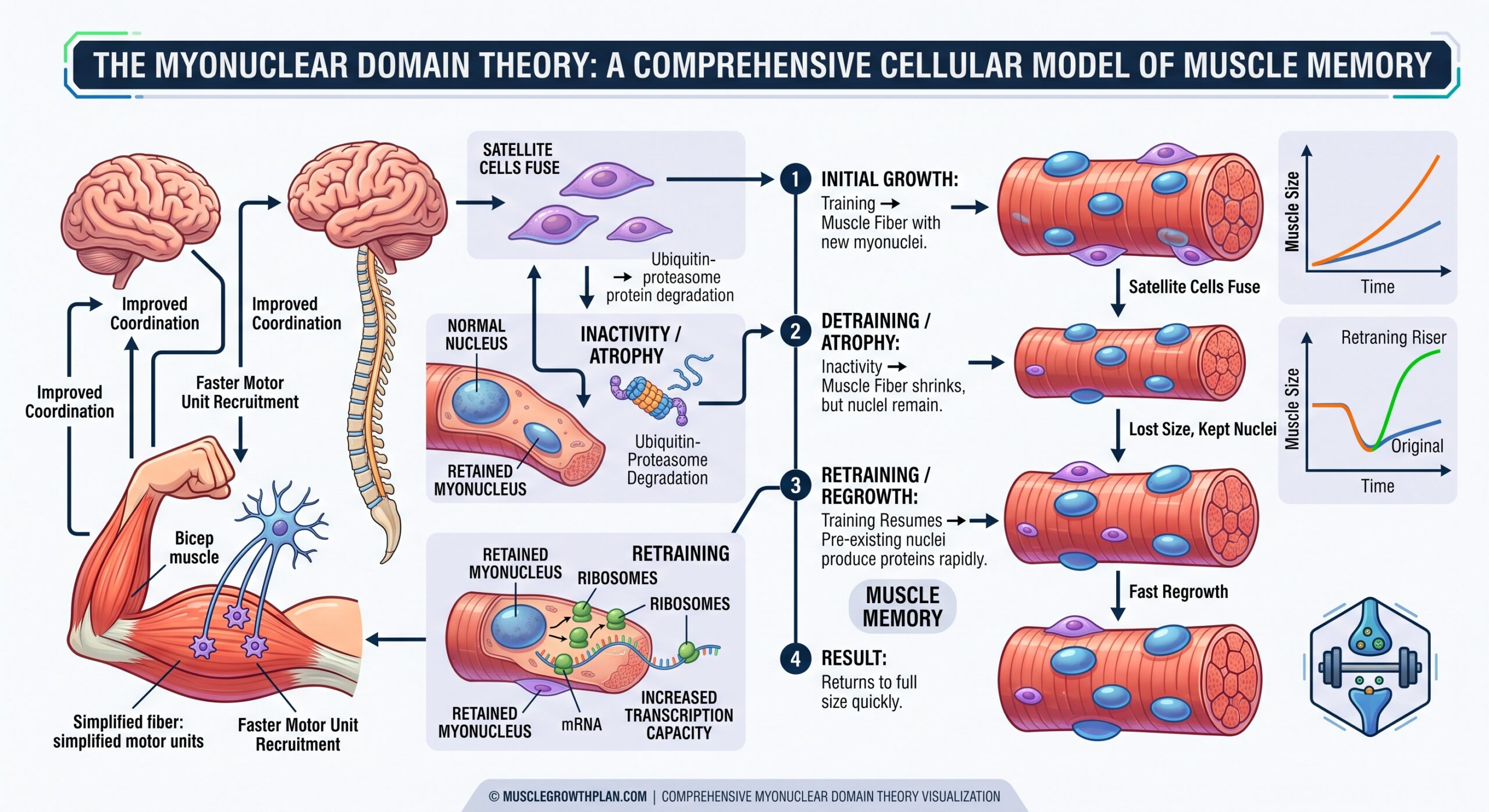
- Retained myonuclei
- DNA methylation changes
- Altered gene expression
- Protein-level adaptations
- Changes involving satellite cells
These adaptations may help previously trained muscle respond more rapidly when it is exposed to resistance training again.
What Are Myonuclei?
Skeletal muscle fibers are unusually large cells containing many nuclei, called myonuclei.
These nuclei help manage:
- Protein production
- Muscle repair
- Gene expression
- Fiber maintenance
- Growth-related processes
As muscle fibers grow, satellite cells can fuse with them and contribute additional myonuclei.
A long-standing muscle-memory theory proposes that some of these added myonuclei remain even when the muscle later shrinks. If they remain, they may provide additional capacity for protein production when training begins again.
Animal research has shown that resistance-type overload can add myonuclei before hypertrophy and that some acquired nuclei may remain during later atrophy.
This led researchers to describe myonuclei as a possible cellular basis of muscle memory.
Are Myonuclei Permanent?
This question is still debated.
Some animal studies suggest that myonuclei gained through training can remain after muscle atrophy, potentially helping the muscle regrow faster.
However, a later meta-analysis concluded that myonuclei are not always permanent and may be lost during severe atrophy or aging.
Human evidence is also less clear than animal evidence. A review examining both animal and human research concluded that the myonuclear theory is biologically plausible but remains difficult to confirm conclusively in people.
The most accurate interpretation is:
Retained myonuclei may contribute to muscle memory, but they are probably not the only mechanism—and they may not remain permanently under every condition.
Epigenetic Muscle Memory
Your DNA sequence generally does not change when you train.
However, training can change how certain genes are regulated.
These regulatory changes are known as epigenetic changes.
One commonly studied epigenetic mechanism is DNA methylation, which can affect whether particular genes become more or less active.
Human research has found that skeletal muscle can retain DNA-methylation patterns after an earlier period of hypertrophy. When the muscle was later retrained, researchers observed a larger number of altered methylation sites than during the initial training phase.
This suggests that muscle cells may retain a molecular record of earlier training.
Animal research has similarly found methylation patterns within muscle nuclei that persisted after training and may have supported a stronger response to retraining.
Researchers sometimes describe this as epigenetic memory.
Proteomic Muscle Memory
Proteomics refers to the study of proteins expressed within a cell or tissue.
A 2025 human study found that some resistance-training-related muscle-protein changes remained after more than two months of detraining. The researchers described this as possible evidence of a retained proteomic memory. Source The Journal of Physiology
This is a developing research area.
It suggests that muscle memory may involve not just:
- Nuclei
- DNA regulation
- Neural pathways
but also lasting changes in the proteins produced by previously trained muscle.
Why Does Lost Strength Return So Quickly?
Strength can return faster than muscle size for several reasons.
Exercise technique returns
You have already learned how to:
- Brace
- Control the weight
- Follow the correct bar path
- Coordinate the movement
- Produce force efficiently
Neural recruitment improves rapidly
The nervous system becomes better at activating the muscle fibers needed for the lift.
Confidence returns
Previously trained people are often less hesitant under heavier loads.
Some muscle may not have been lost
A person can look smaller because of lower glycogen, water, or muscle fullness without having lost all the underlying muscle tissue.
Cellular adaptations may remain
Myonuclear, epigenetic, and protein-related adaptations may help muscle respond more efficiently during retraining.
How Fast Do You Lose Muscle?
Muscle loss does not begin immediately after missing a few workouts.
Short breaks may produce:
- Reduced muscle fullness
- Lower glycogen
- Less water stored inside the muscle
- Slightly worse coordination
- Temporary performance changes
These effects can make you look and feel smaller even when little actual muscle tissue has been lost.
One study found that resistance-trained men maintained their strength gains after two weeks without training.
Longer periods of inactivity can eventually reduce:
- Muscle size
- Strength
- Work capacity
- Exercise tolerance
The rate of loss depends on:
- How long you stop training
- Your training experience
- Age
- Protein and calorie intake
- Illness or injury
- Daily activity
- The severity of immobilization
How Long Does It Take to Regain Lost Muscle?
There is no universal timeline.
However, previously trained people often regain lost strength and muscle faster than it originally took to develop them.
The timeline depends on:
- How much muscle was lost
- How long you were inactive
- Your previous training level
- Age
- Current health
- Nutrition
- Sleep
- How gradually you restart training
A practical, non-guaranteed timeline may look like this:
First two weeks
- Technique improves
- Coordination returns
- Muscles regain glycogen and fullness
- Early strength improvements appear
Weeks three to six
- Working weights begin rising
- Training tolerance improves
- Visible muscle fullness may return
- Soreness becomes more manageable
Weeks six to twelve
- Meaningful strength and muscle can return
- Progress may feel faster than during your original beginner phase
In one older-adult study, eight weeks of retraining restored maximal strength to previously trained levels after detraining.
Another study found that retraining restored muscular performance after a period without structured resistance exercise in older women.
These findings do not guarantee that everyone will regain all lost muscle in eight weeks. They simply demonstrate that retraining can produce substantial recovery.
Does Muscle Memory Last Forever?
Researchers do not know exactly how long every component of muscle memory lasts.
Different forms may persist for different periods.
Motor skills
Well-practiced movement patterns can remain for years, although technique may initially feel rusty.
Myonuclei
Some may remain during periods of atrophy, but evidence suggests they are not necessarily permanent under every circumstance.
Epigenetic changes
Some training-related DNA-methylation patterns may persist after detraining, but researchers are still determining how long they last and how strongly they affect future growth.
Protein adaptations
Some protein-level changes may remain for months, although this field is still developing.
It is safest to say that prior training can leave meaningful biological and neurological traces, but muscle memory should not be viewed as an unlimited lifetime guarantee.
Does Muscle Memory Work After Years Away?
It can.
Someone returning after several years may still have advantages over a complete beginner, including:
- Previous technique
- Exercise familiarity
- Better awareness of effort
- Knowledge of programming
- Established training habits
- Possible retained cellular adaptations
However, after a very long break, aging, injury, illness, and lifestyle changes may slow the return.
A person who trained seriously at 25 and returns at 50 should not immediately resume the exact weights or volume used decades earlier.
The prior experience is valuable, but the restart should still be gradual.
Muscle Memory After Injury
Muscle memory may help during recovery from an injury, but rehabilitation must respect the injured tissue.
You should not assume that because your muscles “remember,” your:
- Tendons
- Ligaments
- Bones
- Joints
- Surgical repairs
are ready for your previous workload.
Muscular strength can return faster than connective tissues adapt.
This creates a risk of doing too much too soon.
When returning after injury:
- Follow medical or rehabilitation guidance
- Restore pain-free range of motion
- Start with conservative loads
- Increase volume gradually
- Monitor swelling and pain
- Avoid testing maximum strength too early
Muscle Memory After Weight Loss
People sometimes lose muscle during aggressive dieting.
If you previously carried more muscle, retraining combined with adequate protein may help you rebuild it.
However, the scale may not change much because:
- Fat may decrease
- Muscle may increase
- Glycogen and water may fluctuate
Use several progress measures:
- Strength
- Circumference measurements
- Progress photos
- Body-weight trends
- Clothing fit
Muscle Memory and Aging
Older adults can retain and regain substantial strength through resistance training.
Research has shown that even very old adults can improve strength and muscle size when they participate in structured resistance training.
This is important because older adults frequently experience interruptions caused by:
- Illness
- Surgery
- Travel
- Joint pain
- Caregiving responsibilities
- Hospitalization
Muscle memory may make previous resistance-training experience especially valuable later in life.
Even when some gains are lost, earlier training was not wasted.
Does Muscle Memory Apply to Cardio and Sports Skills?
Yes, in a broader neurological sense.
The nervous system can retain learned movement patterns from:
- Cycling
- Swimming
- Running
- Throwing
- Martial arts
- Dance
- Olympic lifting
- Team sports
This is why a person returning to cycling may quickly regain balance and technique even though cardiovascular fitness has declined.
However, skill memory does not mean physical conditioning remains unchanged.
You may remember how to perform the activity while lacking your former:
- Endurance
- Strength
- Speed
- Mobility
- Recovery capacity
How to Regain Lost Muscle Safely
1. Do not start where you stopped
Begin with approximately 50%–70% of your former training volume or load, depending on the length and cause of the break.
2. Leave repetitions in reserve
Finish most early sets with three to five good repetitions still possible.
3. Limit soreness
Extreme soreness does not rebuild muscle faster.
Use fewer sets during the first two weeks.
4. Train each muscle consistently
Two weekly sessions per muscle group can work well when volume is moderate.
5. Add load gradually
Increase weight or repetitions only when technique and recovery are good.
6. Eat enough protein
A practical daily range for many lifters is approximately:
1.6–2.2 grams of protein per kilogram of body weight
7. Consume sufficient calories
If rebuilding muscle is the priority, avoid an unnecessarily aggressive calorie deficit.
8. Sleep consistently
Aim for seven to nine hours per night.
9. Track performance
Record weights, repetitions, soreness, and recovery.
Four-Week Muscle-Memory Restart Plan
Week 1: Reintroduce movement
- Two or three full-body sessions
- One or two sets per exercise
- Light-to-moderate weights
- Stop far from failure
Week 2: Add a little volume
- Two or three sets per exercise
- Keep loads manageable
- Practice full range of motion
Week 3: Begin progressive overload
- Add repetitions
- Increase weight slightly where appropriate
- Move closer to normal effort
Week 4: Resume structured training
- Follow a full program
- Keep one to three repetitions in reserve
- Adjust volume according to recovery
Do not rush simply because your strength returns quickly.
Your coordination may improve before your joints and connective tissues are ready for maximum loading.
Can Supplements Speed Up Muscle Memory?
No supplement creates muscle memory.
However, some products may support the retraining process.
Protein powder
Useful when you struggle to reach your daily protein target.
Creatine monohydrate
Can support high-intensity training performance and strength progression.
Electrolytes
Potentially helpful during long, hot, or high-sweat workouts.
Supplements cannot replace:
- Consistent training
- Adequate calories
- Protein
- Sleep
- Gradual load progression
Common Muscle-Memory Myths
Myth 1: You never truly lose muscle
False.
Muscle size and strength can decline during prolonged inactivity.
Muscle memory means recovery may be faster—not that loss never occurs.
Myth 2: Myonuclei remain forever
Not necessarily.
Some research supports retention, while other evidence indicates myonuclei can be lost during atrophy and aging.
Myth 3: You can return at full strength immediately
False.
Coordination may return quickly, but connective tissue and work capacity still require gradual adaptation.
Myth 4: Muscle memory guarantees identical results
False.
Age, health, injury, nutrition, and the length of the break can affect retraining.
Myth 5: Muscle memory only exists in the brain
False.
Neurological memory is important, but research also supports possible cellular, epigenetic, and protein-related memory inside skeletal muscle.
Actionable Protocol: The 4-Week “Return to Lifting” Ramp-Up
The 4-Week Progression Template
| Week | Focus | Intensity (% 1RM) | Target Proximity to Failure (RIR) | Set Volume |
| Week 1 | Re-Activation & Technique | 50% – 55% | 3 – 4 RIR (Very Easy) | 2 sets / exercise |
| Week 2 | Neural Re-Coordination | 60% – 65% | 2 – 3 RIR (Moderate) | 2–3 sets / exercise |
| Week 3 | Hypertrophic Adaptation | 70% – 75% | 1 – 2 RIR (Challenging) | 3 sets / exercise |
| Week 4 | Full Progression Baseline | 75% – 80%+ | 1 RIR / Near Failure | 3–4 sets / exercise |
What is RIR? Reps in Reserve (RIR) indicates how many more clean repetitions you could have performed before hitting technical failure. A 3 RIR means stopping a set with 3 solid reps left in the tank.
Week-by-Week Breakdown
Week 1: Movement Re-Acquisition
-
Primary Objective: Wake up motor pathways, restore joint mobility, and avoid crippling soreness.
-
Volume: 2 working sets per movement pattern (Squat, Hinge, Push, Pull).
-
Execution: Focus entirely on controlled tempos (2-second eccentrics) and strict technique. The weights should feel light and easy.
Week 2: Work Capacity Build
-
Primary Objective: Re-establish training stamina and muscle glycogen storage.
-
Volume: Increase to 2–3 working sets per exercise.
-
Execution: Add a small load increase (5–10 lbs on compounds) while leaving 2–3 reps in reserve.
Week 3: Mechanical Tension Re-Introduction
-
Primary Objective: Stimulate cellular protein synthesis and tap into retained myonuclei.
-
Volume: 3 working sets per exercise.
-
Execution: Increase loads to standard working weights (70–75% 1RM). Muscle fullness and pump will noticeably return during this week.
Week 4: Full Training Integration
-
Primary Objective: Establish your new progressive overload baseline.
-
Volume: Normal training volume (3–4 sets).
-
Execution: Train at full intensity (1 RIR) and begin logging your weekly micro-progressions (adding weight or repetitions) just like a standard training block.
Retraining Best Practices
-
Prioritize Protein Intake: Keep daily protein at 0.8–1.0g per pound of body weight to support rapid structural repair.
-
Stay Hydrated & Replenish Electrolytes: Intracellular glycogen and water return rapidly during retraining; adequate sodium and water intake reduces cramping and pumps muscles faster.
-
Resist the Ego-Lift: Your brain will tell you that you can handle heavier weight before your tendons and ligaments adapt. Stick strictly to the prescribed RIR for the first two weeks.
Frequently Asked Questions
What is muscle memory?
Muscle memory is the retained effect of earlier training that helps you relearn movements and potentially regain lost strength and muscle faster after a break.
Is muscle memory scientifically proven?
The rapid return of strength and performance during retraining is well documented. The exact cellular mechanisms—particularly the permanence of myonuclei—remain under investigation.
How quickly can lost muscle return?
Some people regain noticeable strength and size within several weeks, while larger losses may require several months. The timeline depends on the length of the break, prior training, age, nutrition, and health.
Does muscle return faster than it was originally built?
Often, yes. Relearned technique, neural adaptations, and retained cellular changes may accelerate the retraining response.
Do you lose muscle after two weeks off?
Usually very little actual muscle is lost in only two weeks. You may notice reduced fullness or performance, but one study found that trained men maintained strength after a two-week break.
Can older adults benefit from muscle memory?
Yes. Studies show that older adults can regain strength after detraining and improve muscle through resistance exercise.
Does muscle memory work after an injury?
Previous training may help, but injury recovery must be guided by tissue healing and medical advice. Do not resume former loads immediately.
Frequently Asked Questions About Muscle Memory
How long does muscle memory last?
Neurological adaptations (movement coordination and motor unit recruitment) can persist for months to years, while cellular adaptations—such as added myonuclei and epigenetic DNA-methylation markers—can last anywhere from several years to potentially decades, depending on age, health, and initial training history.
How quickly can you regain lost muscle?
Most returning lifters regain a significant portion of their lost muscle size and strength within 4 to 12 weeks of structured retraining. Because your nervous system and muscle fibers do not need to build new neuromuscular pathways or cellular machinery from scratch, progress is typically twice as fast as initial beginner gains.
Does muscle memory work after a 5 or 10-year break?
Yes. While severe age-related atrophy or extended periods of total inactivity can reduce some cellular adaptations, previously trained individuals still retain baseline neural motor patterns and epigenetic advantages. Even after a decade away, returning lifters rebuild muscle faster than someone who has never touched a barbell.
Do you need to eat in a calorie surplus to regain lost muscle?
Not necessarily. Due to the rapid efficiency of muscle memory, returning lifters can often achieve body recomposition (building muscle while losing fat) by eating at maintenance calories or a slight caloric deficit, provided protein intake remains high (roughly 0.8–1.0g per pound of body weight).
Why do muscles look smaller after just 1 to 2 weeks off?
Short-term size reduction is almost entirely due to depleted muscle glycogen and intracellular water, not actual contractile muscle fiber loss (atrophy). True tissue loss typically doesn’t begin until 2 to 3 consecutive weeks of complete inactivity.
Key Takeaways
Muscle memory is more than a gym myth.
It includes:
- Retained movement skills
- Neural coordination
- Possible retention of myonuclei
- Epigenetic changes
- Persistent protein adaptations
- Faster relearning of training habits
The evidence is strongest for the practical result:
Previously trained people can often regain lost strength and muscle faster than complete beginners build them.
However, the exact cellular explanation is still being refined.
To make the most of muscle memory:
- Restart conservatively.
- Use progressive resistance training.
- Eat enough protein and calories.
- Sleep and recover properly.
- Allow connective tissues time to adapt.
- Measure progress over several weeks.
A training break does not erase everything you built.
You may lose some size, strength, and conditioning—but your previous effort can leave behind skills and adaptations that make the comeback much faster than the original climb.
Continue Learning
Explore these related guides:
- Why You Keep Losing Muscle
- How to Break Through a Muscle-Building Plateau
- Progressive Overload Explained
- Satellite Cells Explained
- Muscle Protein Synthesis Explained
- Hypertrophy Explained
- How Much Protein Do You Need to Build Muscle?
- How Much Sleep Do You Need to Build Muscle?
- Muscle Growth Glossary
Download our FREE 12-Week Muscle Regain Plan for gradual workouts, progressive overload targets, protein guidance, and recovery strategies.
Question: How long were you away from training, and how quickly did your strength return when you started again? Share your experience in the comments.**
Medical Disclaimer
This article provides general educational information and is not medical or rehabilitation advice. Consult a qualified healthcare professional before returning to exercise after surgery, serious illness, prolonged inactivity, or injury.
- 3,000-Calorie Bulking Meal Plan for Muscle Growth
- How to Track Macros for Muscle Growth: Beginner’s Guide
- Best Leg Workout for Muscle Growth: Complete Lower-Body Program
- How Much Water Should You Drink to Build Muscle?
- How to Build a Mind-Muscle Connection for Better Muscle Growth
- 50 High-Protein Foods for Muscle Growth Ranked by Protein per Calorie
- Best 5-Day Workout Split for Muscle Growth
- How to Build Muscle at Home With No Equipment
- Best Shoulder Workout for Mass: Build Bigger, Wider Shoulders
- What Is a Deload Week? Benefits, Timing and How to Do One Properly
Leave a Reply