

rsteelesr79
How Much Protein to Build Muscle
How Much Protein to Build Muscle (Complete Guide)
If you’re serious about building muscle, there’s one thing you cannot ignore:
You can have the best workout plan in the world—but without enough protein, your body simply won’t grow.
In this guide, you’ll learn:
- Exactly how much protein you need
- The best sources of protein
- When to eat protein for maximum growth
- Common mistakes to avoid
Why Protein Is Essential for Muscle Growth
Protein is made up of amino acids, which are the building blocks of muscle tissue.
When you train:
- muscle fibers break down
- your body repairs them
- they grow back bigger and stronger
This process is called muscle protein synthesis.
Without enough protein, this process slows down—or stops.
How Much Protein Do You Need?
The optimal range for muscle growth is:
👉 0.8 to 1 gram of protein per pound of bodyweight
Example
- 150 lbs → 120–150g protein
- 180 lbs → 145–180g protein
- 200 lbs → 160–200g protein
Why This Range Works
- Supports muscle repair
- Maximizes growth
- Prevents muscle loss
Eating more than this won’t significantly increase muscle growth—it just adds calories.
Protein for Beginners vs Advanced Lifters
Beginners
Beginners can often grow with slightly less protein:
👉 ~0.7–0.8g per lb
Intermediate / Advanced
More experienced lifters benefit from:
👉 0.8–1g per lb
Best Protein Sources
Not all protein sources are equal.
Focus on high-quality, complete proteins.
Top Animal-Based Sources
- Chicken breast
- Lean beef
- Eggs
- Fish (salmon, tuna)
- Greek yogurt
Plant-Based Sources
- Lentils
- Chickpeas
- Tofu
- Quinoa
- Vegan protein blends
Quick Tip
Animal proteins are generally:
👉 more complete
👉 easier to absorb
Protein Timing (Does It Matter?)
Timing is less important than total intake—but it still helps.
Best Strategy
- Spread protein across 3–5 meals
- Include protein after workouts
Post-Workout Protein
After training, your muscles are primed for growth.
👉 Aim for 20–40g of protein post-workout
Can You Eat Too Much Protein?
For most people:
👉 No
High protein diets are safe for healthy individuals.
However:
- extremely high intake isn’t necessary
- balance your diet with carbs and fats
Protein Supplements (Are They Needed?)
Protein powder is not required—but it’s very convenient.
Benefits
- quick and easy
- helps hit daily targets
- portable
Best Type
- fast digestion
- high quality
- ideal post-workout
When to Use It
- after workouts
- between meals
- when you can’t hit protein through food
Common Protein Mistakes
1. Not Eating Enough Protein
This is the most common issue.
2. Relying Only on Supplements
Whole foods should be your foundation.
3. Skipping Meals
You need consistent intake throughout the day.
4. Not Tracking Intake
Most people underestimate how much they eat.
Sample Daily Protein Plan
Example (180 lbs individual)
Breakfast
- Eggs + toast → 30g
Lunch
- Chicken + rice → 40g
Snack
- Protein shake → 25g
Dinner
- Steak + vegetables → 45g
Total
👉 ~140–160g protein
How Protein Fits Into Your Overall Diet
Protein is just one part of the equation.
You also need:
- carbohydrates (for energy)
- fats (for hormones)
Ideal Balance
- Protein: 25–35%
- Carbs: 40–50%
- Fats: 20–30%
Does Protein Help With Fat Loss?
Yes.
Higher protein intake:
- preserves muscle
- reduces hunger
- improves body composition
Final Thoughts
If you want to build muscle faster, protein is non-negotiable.
Focus on:
- hitting your daily target
- choosing quality sources
- staying consistent
Do this, and your results will improve dramatically.
Call to Action
If you want a complete system that includes your exact nutrition and workout plan:
Download your free 12-week muscle growth plan and start building muscle the right way.
Best Workout Split For Muscle Growth
Best Workout Split for Muscle Growth (Complete Guide)
If you’ve ever wondered…
👉 “What’s the best workout split to build muscle fast?”
You’re not alone.
The truth is, your workout split can either accelerate your gains or completely stall your progress.
In this guide, you’ll learn:
- The best workout splits for each level
- How to choose the right one
- How to structure your week for maximum growth
What Is a Workout Split?
A workout split is how you divide your training across the week.
Instead of training your whole body every day, you organize workouts to target specific muscle groups.
Examples:
- Full body
- Upper/lower
- Push pull legs
Why Your Workout Split Matters
Your split determines:
- training frequency
- recovery time
- total volume
The goal is simple:
👉 Train enough to grow
👉 Recover enough to improve
The Most Important Rule
Before choosing any split, understand this:
👉 You should train each muscle group at least 2 times per week
This is one of the biggest drivers of muscle growth.
Best Workout Splits (By Level)
1. Full Body Split (Best for Beginners)
Structure
- 3 workouts per week
- each workout hits the entire body
Example
Day 1
- Squats
- Bench press
- Rows
Day 2
- Deadlifts
- Overhead press
- Pull-ups
Day 3
- Leg press
- Incline press
- Lat pulldown
Benefits
- high frequency
- simple structure
- fast strength gains
Who Should Use It
- beginners
- busy schedules
- people returning to the gym
2. Upper Lower Split (Best for Intermediate)
Structure
- 4 days per week
- 2 upper + 2 lower
Example
Day 1: Upper
- Bench press
- Rows
- Shoulder press
Day 2: Lower
- Squats
- Romanian deadlifts
- Lunges
Day 3: Rest
Day 4: Upper
Day 5: Lower
Benefits
- balanced volume
- great recovery
- easy to follow
Who Should Use It
- intermediate lifters
- those training 4 days/week
3. Push Pull Legs (Best for Growth)
Structure
- 3–6 days per week
Breakdown
Push
- chest
- shoulders
- triceps
Pull
- back
- biceps
Legs
- quads
- hamstrings
- calves
Example
Day 1: Push
- Bench press
- Shoulder press
- Tricep pushdowns
Day 2: Pull
- Deadlifts
- Rows
- Bicep curls
Day 3: Legs
- Squats
- Lunges
- Calf raises
Benefits
- high volume
- logical structure
- excellent hypertrophy
Who Should Use It
- intermediate to advanced lifters
- those training 5–6 days/week
4. 5-Day Bro Split (Advanced Only)
Structure
- 1 muscle group per day
Example:
- Chest
- Back
- Shoulders
- Arms
- Legs
Pros
- focused workouts
- high volume per muscle
Cons
- low frequency (1x/week)
- slower growth for most people
Recommendation
Only use if:
- you’re advanced
- you already built a solid base
How to Choose the Right Split
Use this simple rule:
- 3 days/week → Full body
- 4 days/week → Upper/lower
- 5–6 days/week → Push pull legs
Weekly Training Volume
For muscle growth:
👉 10–20 sets per muscle group per week
Split your volume across your training days.
Rest and Recovery
Muscle grows when you recover.
Make sure you:
- sleep 7–9 hours
- allow 48 hours between muscle groups
- avoid overtraining
Common Mistakes
1. Training Each Muscle Only Once Per Week
This slows growth dramatically.
2. Too Much Volume
More isn’t always better.
3. Switching Programs Too Often
Stick with a plan for at least 8–12 weeks.
4. Ignoring Progressive Overload
Your split doesn’t matter if you’re not progressing.
Sample Weekly Plans
3-Day Beginner Plan
- Monday: Full body
- Wednesday: Full body
- Friday: Full body
4-Day Intermediate Plan
- Monday: Upper
- Tuesday: Lower
- Thursday: Upper
- Friday: Lower
6-Day Advanced Plan
- Push
- Pull
- Legs
- Push
- Pull
- Legs
How to Maximize Your Results
Regardless of your split:
- train with intensity
- track your progress
- eat enough protein
- stay consistent
Final Thoughts
There is no single “perfect” workout split.
The best split is:
👉 The one you can follow consistently
👉 The one that allows progression
👉 The one that fits your schedule
Call to Action
If you want a complete system based on these principles:
Download your free 12-week muscle growth plan and start training with structure and purpose.
How to Build Muscle Fast (Science-Based Guide)
How to Build Muscle Fast (Science-Based Guide)
If you’ve been going to the gym and not seeing results, you’re not alone.
Most people train hard—but not smart. They follow random workouts, ignore nutrition, and expect muscle to magically appear.
Here’s the truth:
Building muscle fast isn’t about doing more… it’s about doing the right things consistently.
In this guide, you’ll learn exactly how to:
- Build muscle efficiently
- Avoid common mistakes
- Maximize your results in the shortest time possible
What Actually Builds Muscle?
Muscle growth (hypertrophy) happens when your body adapts to stress.
That stress comes from:
- resistance training
- proper nutrition
- recovery
If even one of these is missing, your results slow down—or stop completely.
Step 1: Train With Progressive Overload
The most important principle in muscle building is progressive overload.
This means gradually increasing the demands placed on your muscles over time.
How to Apply It
You can progressively overload by:
- Increasing weight
- Adding reps
- Improving form
- Reducing rest time
Example
Week 1: Bench press 135 lbs × 8 reps
Week 2: Bench press 135 lbs × 10 reps
Week 3: Bench press 145 lbs × 8 reps
That’s growth.
If you lift the same weight every week, your body has no reason to change.
Step 2: Follow a Structured Workout Plan
One of the biggest mistakes beginners make is training without a plan.
Random workouts lead to random results.
Best Workout Splits
Choose a split based on your experience level:
- Beginner → Full body (3x/week)
- Intermediate → Upper/Lower (4x/week)
- Advanced → Push Pull Legs (5–6x/week)
The key is consistency—not complexity.
Step 3: Train Each Muscle Twice Per Week
Research shows that training each muscle group at least 2 times per week leads to better muscle growth.
Why It Works
- More frequent stimulation
- Better recovery balance
- Increased weekly volume
Step 4: Eat in a Calorie Surplus
You cannot build muscle without enough fuel.
Your body needs extra energy to grow.
How Much to Eat
Start with:
👉 +200–300 calories above maintenance
Example
Maintenance: 2,500 calories
Muscle growth: 2,700–2,800 calories
Too much surplus = fat gain
Too little = no growth
Step 5: Prioritize Protein Intake
Protein is the building block of muscle.
Without enough protein, your body cannot repair and grow muscle tissue.
Daily Protein Target
👉 0.8–1 gram per pound of bodyweight
Example
- 150 lbs → 120–150g protein
- 180 lbs → 145–180g protein
Best Protein Sources
- Chicken breast
- Eggs
- Lean beef
- Greek yogurt
- Whey protein
Step 6: Get Enough Sleep
Sleep is where muscle growth actually happens.
During sleep:
- hormones are released
- muscles repair
- recovery occurs
Ideal Sleep Range
👉 7–9 hours per night
Lack of sleep = slower gains.
Step 7: Stay Consistent
This is the part most people fail.
They:
- skip workouts
- change programs too often
- give up too early
Muscle building takes time.
Realistic Expectations
- Beginners: 1–2 lbs muscle per month
- Intermediate: 0.5–1 lb per month
- Advanced: slower
Consistency beats everything.
Step 8: Use Supplements (Optional)
Supplements are not required—but they can help.
Best Supplements
Creatine
- increases strength
- improves performance
Protein Powder
- helps hit daily protein goals
Avoid wasting money on unnecessary supplements.
Step 9: Avoid Common Mistakes
1. Not Eating Enough
Most people underestimate how much they eat.
2. No Progressive Overload
Lifting the same weights = no growth.
3. Program Hopping
Stick to a plan for at least 8–12 weeks.
4. Ignoring Recovery
More is not always better.
Step 10: Track Your Progress
What gets measured gets improved.
Track:
- body weight
- strength
- workouts
This allows you to adjust and improve over time.
Sample Weekly Plan
4-Day Upper/Lower Split
Day 1: Upper
- Bench press
- Rows
- Shoulder press
Day 2: Lower
- Squats
- Deadlifts
- Lunges
Day 3: Rest
Day 4: Upper
Day 5: Lower
Final Thoughts
Building muscle fast isn’t complicated—but it does require discipline.
Focus on:
- progressive overload
- proper nutrition
- consistency
Do that, and results will come.
Call to Action
If you want a done-for-you system:
Download your free 12-week muscle growth plan and start building muscle the right way.
The Importance of Cooling Down After a Workout



Introduction: The Most Overlooked Step in Fitness
Many people spend hours planning their workouts. They carefully choose exercises, count reps, track calories, and push themselves to the limit in the gym.
But the moment the workout ends?
They grab their water bottle, check their phone, and walk straight out of the gym.
No cooldown. No stretching. No recovery.
Skipping the cooldown phase is one of the most common mistakes in fitness—and it can lead to unnecessary soreness, reduced flexibility, slower recovery, and even injury.
If you’re serious about building muscle, improving endurance, or maintaining long-term health, understanding the importance of cooling down after a workout is essential.
In this guide, you’ll learn:
- What a cooldown actually does for your body
- The science behind post-workout recovery
- How cooling down prevents injury
- The best cooldown exercises for recovery
- How long your cooldown should be
By the end of this article, you’ll understand why a proper cooldown may be just as important as the workout itself.
What Is a Cooldown After a Workout?
A cooldown is a short period of light activity and stretching performed after exercise to help your body gradually return to its resting state.
Instead of stopping abruptly after intense activity, a cooldown allows your body to slowly adjust.
A proper cooldown usually includes:
• Light cardio (walking or slow cycling)
• Stretching major muscle groups
• Controlled breathing
• Mobility exercises
This process helps regulate:
- Heart rate
- Blood circulation
- Muscle tension
- Oxygen delivery
Without a cooldown, your body may experience sudden changes in circulation and muscle tightness, which can increase discomfort and slow recovery.
Why Cooling Down Is Important After Exercise
1. Helps Your Heart Rate Return to Normal


During intense exercise, your heart rate increases to pump oxygen-rich blood to your muscles.
If you stop suddenly:
- blood can pool in your legs
- dizziness may occur
- blood pressure can drop quickly
Cooling down allows your cardiovascular system to gradually return to normal, reducing stress on the heart.
Even just 5 minutes of light movement can help stabilize circulation.
2. Reduces Muscle Stiffness and Soreness
After a workout, your muscles contain metabolic byproducts such as lactic acid and other waste compounds.
A cooldown helps:
- increase circulation
- flush waste products
- deliver nutrients to muscles
This can reduce delayed onset muscle soreness (DOMS) and help muscles recover faster.
While soreness is normal after intense workouts, proper recovery practices—like cooling down—can minimize excessive stiffness.
3. Improves Flexibility and Mobility
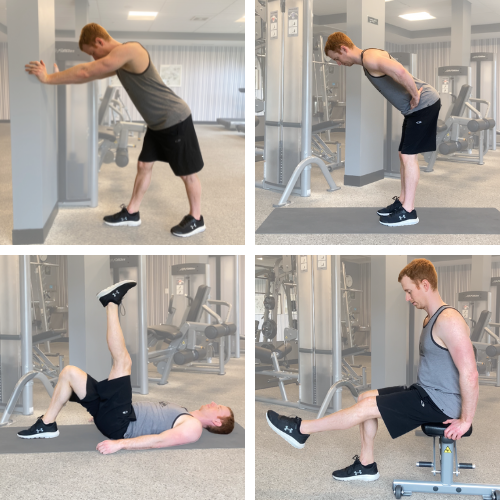



Your muscles are warm and more flexible immediately after exercise.
This makes the cooldown phase the perfect time for stretching.
Regular post-workout stretching can help:
- improve flexibility
- increase joint mobility
- reduce muscle tightness
- enhance athletic performance
Over time, better mobility can also help improve exercise form and reduce injury risk.
4. Prevents Injury
Many injuries occur when muscles become tight, fatigued, or overworked.
Cooling down helps your body transition safely from high-intensity exercise to rest.
This process helps prevent:
- muscle strains
- ligament stress
- joint stiffness
- overtraining fatigue
Athletes and trainers consistently emphasize cooldown routines because they help keep the body balanced and injury-resistant.
5. Supports Faster Recovery
Recovery is where real muscle growth happens.
When you train, you create microscopic tears in muscle fibers. During recovery, the body repairs those fibers, making them stronger.
Cooling down supports this process by:
- improving blood flow
- delivering nutrients to muscles
- reducing muscle tension
- promoting relaxation
A proper cooldown can help your body transition from training mode to recovery mode.
The Science Behind Cooling Down
Scientific research has shown that active recovery can improve post-exercise circulation.
According to research published in The Journal of Strength and Conditioning Research, light activity after exercise can enhance blood flow and reduce muscle fatigue.
Other studies suggest that cooling down may help regulate:
- oxygen levels
- metabolic waste removal
- muscle elasticity
While a cooldown won’t eliminate soreness entirely, it can significantly improve overall recovery quality.
How Long Should a Cooldown Be?
A typical cooldown should last 5 to 10 minutes.
This gives your body enough time to gradually transition back to resting levels.
General guideline
| Workout Type | Recommended Cooldown |
|---|---|
| Strength training | 5–10 minutes |
| Cardio workouts | 5–10 minutes |
| High intensity training | 10 minutes |
The more intense the workout, the more beneficial a longer cooldown may be.
The Best Cooldown Exercises
1. Light Walking
The easiest cooldown activity is simply walking slowly for several minutes.
This allows your heart rate and breathing to stabilize.
Examples:
- walk around the gym
- slow treadmill walk
- light jog transitioning to walking
2. Hamstring Stretch
This stretch targets the muscles at the back of your legs.
Benefits:
- reduces lower body tightness
- improves flexibility
- supports recovery from running or leg workouts
Hold each stretch for 20–30 seconds.
3. Quadriceps Stretch
The quadriceps are heavily used during squats, lunges, and running.
Stretching them helps prevent tightness and improve mobility.
4. Shoulder and Upper Body Stretch
After upper body workouts, focus on:
- shoulders
- chest
- triceps
- upper back
This helps relieve tension created by pressing and pulling exercises.
5. Deep Breathing Exercises
Cooling down is also a great time to practice controlled breathing.
Deep breathing helps:
- reduce stress
- lower heart rate
- activate the body’s recovery system
Try slow breathing patterns:
Inhale for 4 seconds
Exhale for 6 seconds
This activates the parasympathetic nervous system, which promotes relaxation.
Common Cooldown Mistakes
Even when people attempt a cooldown, they often make mistakes.
Skipping it entirely
The most common mistake is not cooling down at all.
Even 5 minutes can make a difference.
Stretching cold muscles
Stretching is most effective after exercise, not before.
Warm muscles respond better to stretching and reduce injury risk.
Rushing through stretches
Many people hold stretches for only a few seconds.
For best results:
Hold stretches 20–30 seconds.
Only stretching one muscle group
A balanced cooldown should address multiple muscle groups.
Focus on:
- legs
- hips
- back
- shoulders
Cooling Down vs Warming Up
Many people confuse warmups and cooldowns, but they serve different purposes.
| Warmup | Cooldown |
|---|---|
| Prepares the body for exercise | Helps the body recover |
| Raises heart rate | Lowers heart rate |
| Activates muscles | Relaxes muscles |
| Prevents injury before exercise | Supports recovery after exercise |
Both are essential parts of a complete workout routine.
Benefits of Cooling Down for Athletes
For athletes and serious lifters, cooldown routines can improve:
- long-term performance
- mobility
- recovery speed
- injury prevention
Professional athletes rarely skip cooldowns because they understand that recovery determines performance longevity.
Consistent cooldown routines can help athletes train harder, more frequently, and with fewer injuries.
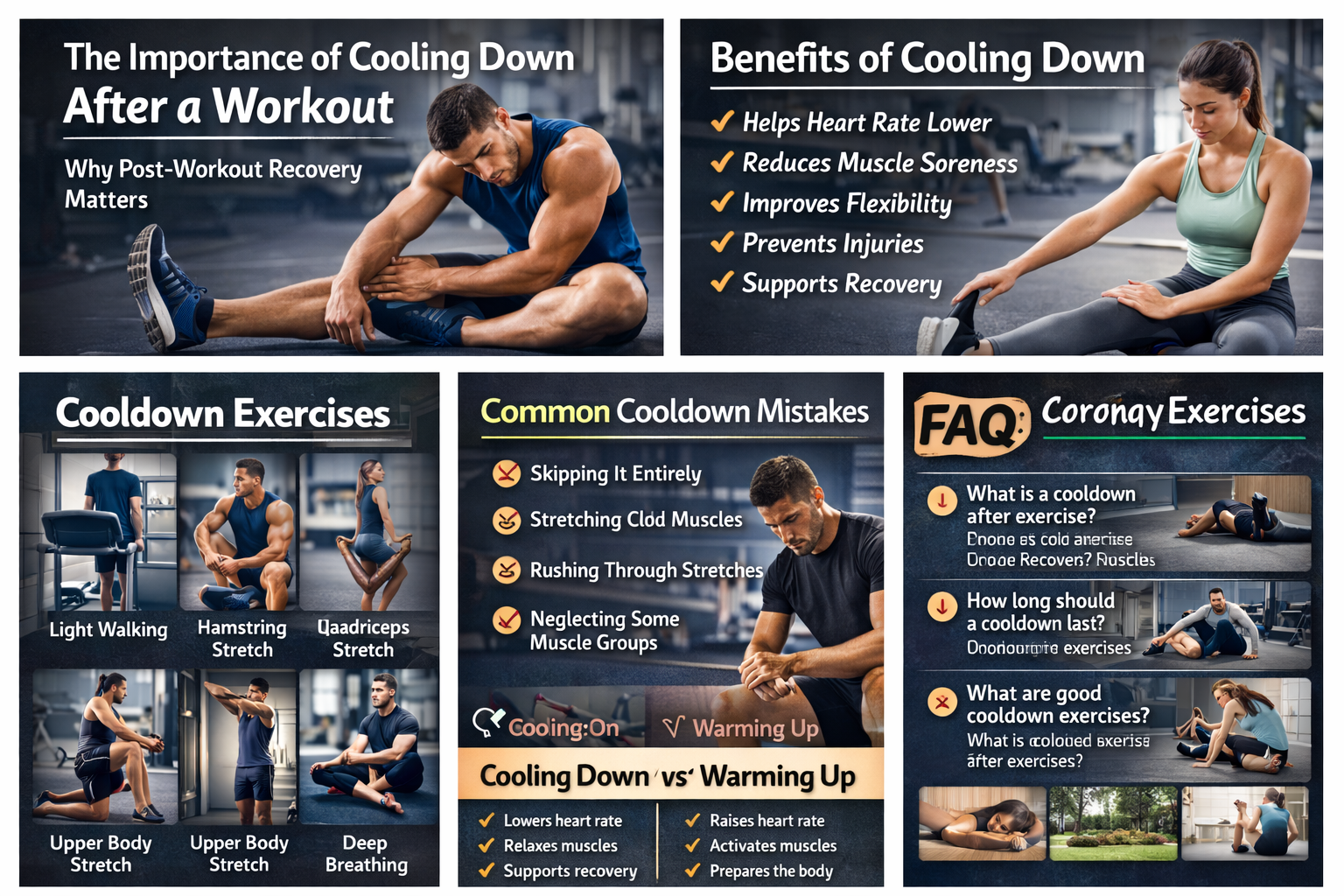
Key Takeaways
Cooling down after exercise is one of the most important yet overlooked steps in fitness.
A proper cooldown helps:
✔ Gradually lower heart rate
✔ Reduce muscle soreness
✔ Improve flexibility
✔ Prevent injuries
✔ Support faster recovery
Even a short 5–10 minute cooldown routine can significantly improve how your body feels after training.
Final Thoughts
If you’re serious about improving your fitness, strength, and overall health, don’t let the end of your workout be the weakest part of your routine.
Cooling down is not just an optional step—it’s an essential part of long-term performance and injury prevention.
By adding a simple cooldown routine to your workouts, you can recover faster, feel better, and continue making progress toward your fitness goals.
Your body works hard during exercise.
Give it the recovery it deserves.
Do you currently include a cooldown routine after your workouts, or do you usually skip it?
Share your experience in the comments!
The Importance of Fiber in Your Diet
Introduction: The Missing Nutrient in Modern Diets
Most people trying to improve their fitness or health focus on **protein, calories, and supplements**. But one of the most powerful nutrients for **fat loss, digestion, muscle performance, and overall health** is often ignored.
That nutrient is **fiber**.
In fact, studies show that **over 90% of adults fail to meet the recommended daily intake of fiber**. The result? Poor digestion, unstable energy levels, stubborn body fat, gut issues, and increased risk of chronic disease.
If you’re working hard in the gym but still struggling with **fat loss, bloating, or hunger**, your fiber intake could be the missing piece.
In this guide, you’ll learn:
* What fiber actually is
* Why fiber is critical for **muscle growth and fat loss**
* The two types of fiber and how they work
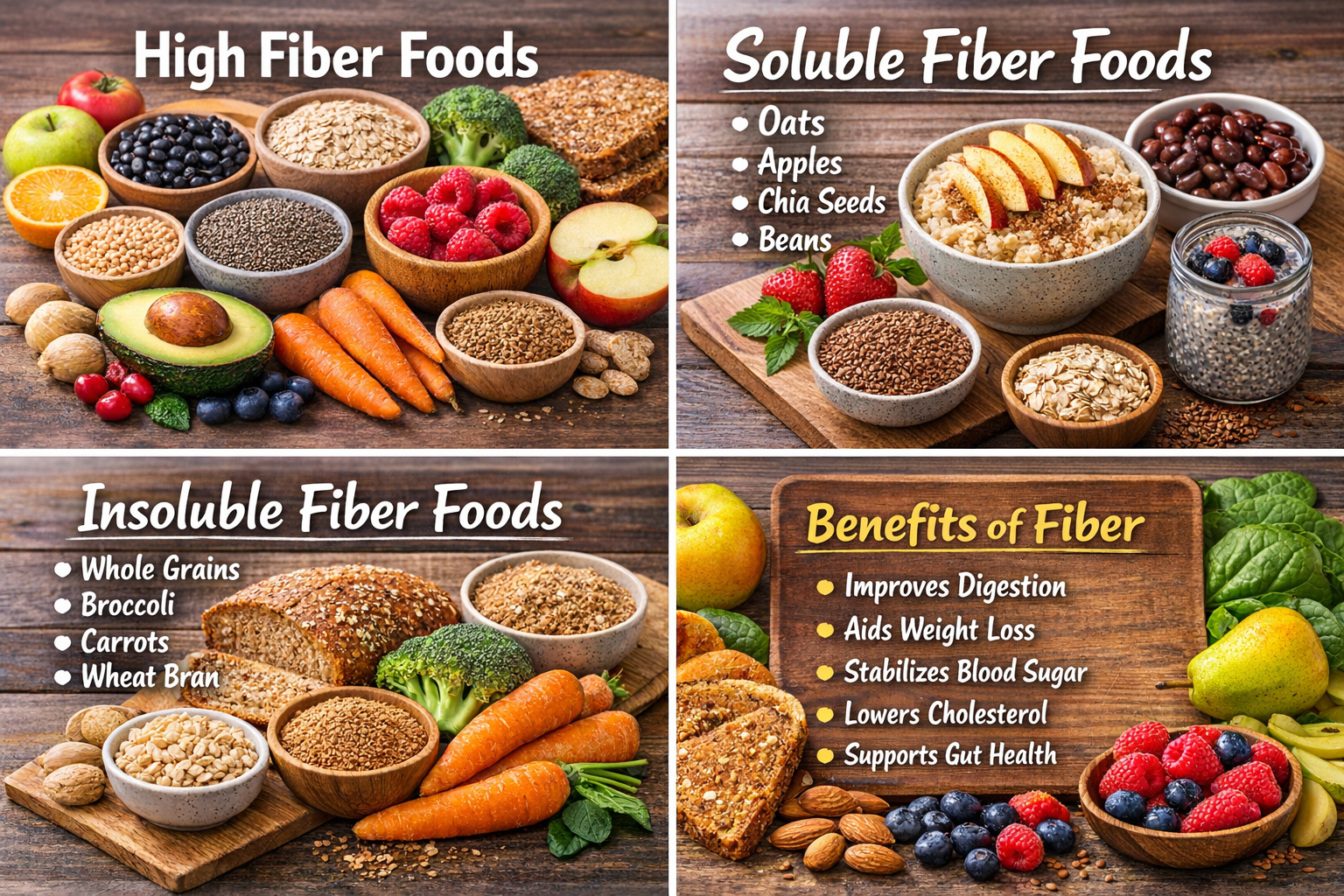
* The best **high-fiber foods**
* How much fiber you should eat daily
* Simple ways to increase fiber intake without digestive discomfort
By the end, you’ll understand why fiber may be one of the **most underrated nutrients in fitness and health**.
What Is Fiber?
Dietary fiber is a type of **carbohydrate found in plant foods** that your body cannot fully digest.
Unlike sugars or starches, fiber passes through the digestive system largely intact. While that may sound useless, it actually provides **massive benefits to digestion, metabolism, and gut health**.
Fiber plays several important roles:
* Supports healthy digestion
* Helps regulate blood sugar
* Promotes fullness and appetite control
* Feeds beneficial gut bacteria
* Reduces cholesterol levels
* Supports long-term metabolic health
But not all fiber works the same way.
There are **two main types of fiber**, and both are essential.
—
The Two Types of Fiber
1. Soluble Fiber
Soluble fiber dissolves in water and forms a **gel-like substance** in your digestive system.
This slows digestion and helps regulate nutrient absorption.
Benefits of soluble fiber
• Helps lower LDL cholesterol
• Stabilizes blood sugar levels
• Improves heart health
• Feeds healthy gut bacteria
• Helps you stay full longer
Foods rich in soluble fiber
* Oats
* Beans
* Lentils
* Apples
* Citrus fruits
* Chia seeds
* Flax seeds
* Barley
Soluble fiber is especially useful for people trying to **lose body fat or control hunger**.
—
2. Insoluble Fiber
Insoluble fiber does **not dissolve in water**. Instead, it adds bulk to stool and helps food move efficiently through the digestive tract.
Benefits of insoluble fiber
• Prevents constipation
• Improves digestion
• Supports gut health
• Helps maintain bowel regularity
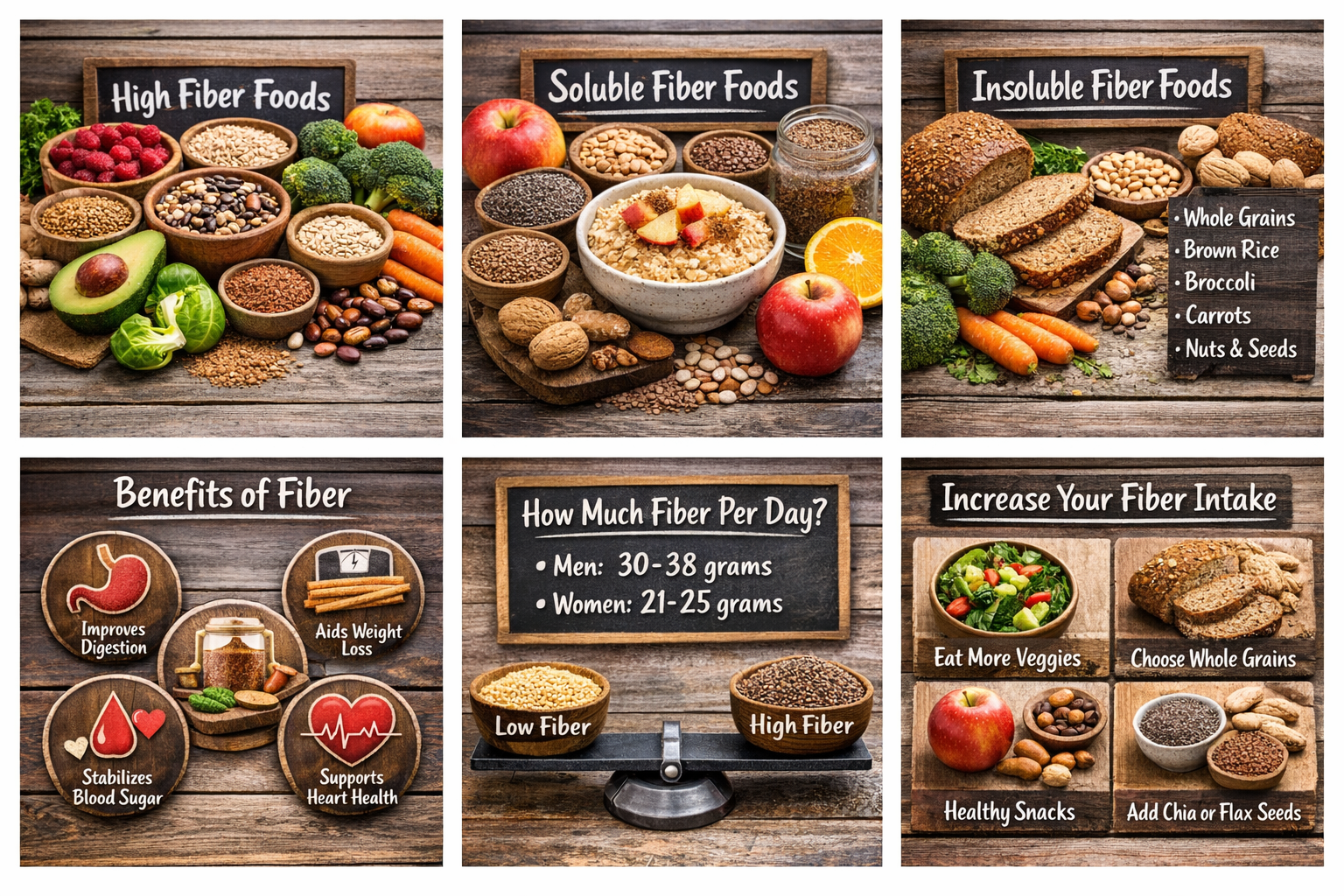
Foods rich in insoluble fiber
* Whole grains
* Brown rice
* Broccoli
* Carrots
* Leafy greens
* Nuts
* Seeds
* Wheat bran
Think of insoluble fiber as the **clean-up crew for your digestive system**.
—
Why Fiber Matters for Muscle Growth and Fitness
Many people associate fiber with digestion, but it also plays an important role in **fitness performance and body composition**.
1. Fiber Helps Control Body Fat
Fiber slows digestion and keeps you feeling full longer.
That means:
* Less snacking
* Fewer calorie spikes
* Better appetite control
Research consistently shows that people who eat **higher fiber diets naturally consume fewer calories**.
For athletes or anyone trying to get lean, fiber helps make dieting **much easier to sustain**.
—
2. Fiber Improves Gut Health
Your gut contains trillions of bacteria known as the **gut microbiome**.
These bacteria influence:
* metabolism
* inflammation
* nutrient absorption
* immune health
Fiber acts as **fuel for beneficial gut bacteria**, allowing them to produce compounds called **short-chain fatty acids**, which support metabolic health.
A healthier gut microbiome has been linked to:
* improved fat loss
* better digestion
* improved nutrient absorption
—
3. Fiber Stabilizes Blood Sugar
Large spikes in blood sugar can lead to:
* energy crashes
* cravings
* fat storage
Fiber slows the absorption of carbohydrates, helping maintain **stable blood sugar levels** throughout the day.
Stable blood sugar means:
* consistent energy
* fewer cravings
* improved workout performance
—
4. Fiber Supports Heart Health
Athletes and lifters often focus only on physique, but **long-term cardiovascular health matters too**.
Soluble fiber helps reduce LDL cholesterol by binding to cholesterol particles and removing them from the body.
A diet rich in fiber is associated with lower risk of:
* heart disease
* stroke
* metabolic syndrome
—
How Much Fiber Should You Eat?
According to most health organizations:
| Group | Recommended Daily Fiber |
|---|---|
| Men | 30–38 grams |
| Women | 21–25 grams |
However, many fitness experts recommend **25–40 grams per day** depending on calorie intake.
The problem?
The average person only eats **10–15 grams daily**.
That means most people are consuming **less than half** of the fiber their bodies need.
—
The Best High-Fiber Foods
Here are some of the **most fiber-dense foods you can add to your diet**.
Fruits
* Raspberries – 8g per cup
* Pears – 6g per fruit
* Apples – 4g per fruit
* Bananas – 3g per fruit
Vegetables
* Broccoli – 5g per cup
* Brussels sprouts – 4g per cup
* Carrots – 4g per cup
* Sweet potatoes – 4g per potato
Whole Grains
* Oats – 4g per cup
* Quinoa – 5g per cup
* Brown rice – 3g per cup
* Whole wheat bread – 3g per slice
Legumes
* Lentils – 15g per cup
* Black beans – 15g per cup
* Chickpeas – 12g per cup
Seeds and Nuts
* Chia seeds – 10g per ounce
* Flax seeds – 8g per tablespoon
* Almonds – 4g per ounce
These foods provide **fiber along with vitamins, minerals, and antioxidants**, making them far superior to processed foods.
Simple Ways to Increase Fiber Intake
Increasing fiber doesn’t require a complete diet overhaul.
Small changes can make a big difference.
1. Start Your Day With Fiber
Instead of sugary cereal, try:
* oatmeal with berries
* chia pudding
* whole grain toast with avocado
This can give you **8–15 grams of fiber before noon**.
—
2. Add Vegetables to Every Meal
Vegetables are one of the easiest ways to increase fiber.
Examples:
* spinach in omelets
* broccoli with lunch
* roasted vegetables at dinner
—
3. Choose Whole Grains
Swap refined carbs for whole grains:
| Instead of | Try |
| ————- | —————– |
| White bread | Whole grain bread |
| White rice | Brown rice |
| Regular pasta | Whole wheat pasta |
—
4. Snack Smarter
High-fiber snacks include:
* apples with peanut butter
* almonds
* carrots and hummus
* protein smoothies with chia seeds
—
5. Use Fiber Boosters
Adding small ingredients can dramatically increase fiber intake:
* chia seeds
* flax seeds
* psyllium husk
* oat bran
Just one tablespoon can add **5–10 grams of fiber**.
—
Common Fiber Mistakes
Increasing Fiber Too Quickly
If you suddenly jump from **10 grams to 40 grams**, you may experience:
* bloating
* gas
* stomach discomfort
Increase fiber **gradually over 1–2 weeks**.
—
Not Drinking Enough Water
Fiber absorbs water.
Without enough hydration, fiber can cause **constipation instead of preventing it**.
Aim for **at least 2–3 liters of water daily**.
—
Relying on Processed Fiber Foods
Many products claim to be “high fiber” but are still ultra-processed.
Whole foods provide **better nutrients and better gut support**.
—
Fiber and Fat Loss: A Powerful Combination
One of the simplest ways to lose body fat without extreme dieting is to increase fiber intake.
Fiber helps by:
* reducing hunger
* lowering calorie intake
* improving digestion
* stabilizing blood sugar
* supporting gut health
Some researchers even suggest that **fiber intake may be one of the strongest predictors of successful weight loss**.
That’s why many successful nutrition plans naturally include high-fiber foods.
—
Key Takeaways
Fiber is one of the most **underrated nutrients in health and fitness**.
When consumed regularly, it can:
✔ Improve digestion
✔ Support fat loss
✔ Stabilize blood sugar
✔ Improve gut health
✔ Lower cholesterol
✔ Help control hunger
Yet most people consume **less than half the fiber their body needs**.
The good news is that improving your fiber intake is simple:
* Eat more whole foods
* Add vegetables to meals
* Choose whole grains
* Include legumes and seeds
Small daily changes can make a **huge difference in long-term health and performance**.
FAQ: Fiber and Your Diet
What does fiber do for your body?
Fiber supports digestion, regulates blood sugar, lowers cholesterol, and helps control hunger. It also feeds beneficial gut bacteria that support overall health.
What foods are highest in fiber?
Some of the highest fiber foods include lentils, beans, chia seeds, oats, raspberries, pears, broccoli, and whole grains.
How much fiber should you eat per day?
Most adults should consume 25–38 grams of fiber per day, depending on age and gender.
Is fiber good for weight loss?
Yes. Fiber helps control hunger and keeps you feeling full longer, which can naturally reduce calorie intake and support weight loss.
—
Final Thoughts
If you’re serious about improving your health, body composition, and overall performance, **fiber should be a daily priority**.
Instead of chasing complicated diets or expensive supplements, start by focusing on the basics.
Whole foods. Balanced meals. Adequate fiber.
Your body — and your gut — will thank you.
—
What are your favorite high-fiber foods that help you stay full and energized throughout the day?
Let us know in the comments below!
Free Muscle Growth Plan Generator
Best Hypertrophy Workout Plan for Maximum Muscle Growth
Best Plan for Hyper Muscle Growth (Hypertrophy):
The Complete Muscle-Building Program
You train hard.
You finish workouts exhausted.
You chase the pump.
But months later, your physique barely looks different.
The problem may not be effort.
It may be that your training program isn’t actually designed around hypertrophy.
Hypertrophy simply means an increase in muscle size. And while almost any resistance training can build some muscle—especially for beginners—the best muscle-building programs consistently apply a handful of principles:
- Train each major muscle regularly
- Perform enough challenging weekly sets
- Use a combination of compound and isolation exercises
- Train reasonably close to muscular failure
- Progress your exercises over time
- Eat enough protein and calories
- Recover between sessions
- Follow the program long enough for adaptation to occur
You don’t need 30 exercises.
You don’t need two-hour workouts.
And you definitely don’t need to destroy each muscle once every seven days.
This guide gives you a complete hypertrophy workout plan built around those fundamentals.
What Is Hypertrophy Training?
Muscular hypertrophy is the enlargement of skeletal muscle fibers in response to training and adequate recovery.
Resistance training creates a stimulus.
Your body then adapts to repeated training demands by increasing its ability to produce force and, under the right conditions, increasing muscle size.
The basic process looks like this:
Resistance Training → Recovery + Nutrition → Adaptation → Bigger/Stronger Muscle
Hypertrophy training therefore isn’t about simply making a muscle burn.
Your program needs to provide enough muscular tension and effort while still allowing you to recover and repeat productive training.
The 7 Rules of Maximum Muscle Growth
Before getting into the workout, understand these seven principles.
1. Progressive Overload
If you bench 135 pounds for eight repetitions forever, your body has little reason to keep adapting.
Progressive overload means gradually increasing the demands placed on your muscles.
You can progress through:
- More weight
- More repetitions
- Additional productive sets
- Better technique
- Greater controlled range of motion
- Harder exercise variations
For hypertrophy, the easiest method is usually:
Increase repetitions first, then increase weight.
We’ll explain exactly how to do this later.
2. Train Each Muscle About Twice Per Week
You can build muscle training a body part once weekly.
However, spreading your weekly volume across approximately two sessions often makes it easier to perform high-quality sets without turning one workout into a marathon.
For example:
Instead of doing 16 chest sets on Monday, you might perform:
Monday: 8 chest sets
and
Thursday: 8 chest sets
This gives you another opportunity to stimulate the muscle while distributing fatigue.
Training frequency itself isn’t magic—the weekly training stimulus and your ability to recover remain critical.
3. Perform Enough Weekly Sets
Training volume is commonly measured using the number of challenging sets performed for each muscle every week.
There is no perfect number for everyone.
A useful starting range for many lifters is approximately:
10–20 challenging sets per muscle group per week.
Beginners usually need less.
Advanced lifters may sometimes benefit from more.
More volume is not automatically better.
Twenty high-quality sets you recover from are useful.
Thirty-five sets that destroy your performance for the rest of the week are not.
Good starting targets
| Muscle | Weekly Sets |
|---|---|
| Chest | 10–16 |
| Back | 12–18 |
| Quads | 10–16 |
| Hamstrings | 8–14 |
| Glutes | 8–16 |
| Shoulders | 10–16 |
| Biceps | 8–14 |
| Triceps | 8–14 |
| Calves | 8–16 |
Remember that compound exercises contribute to multiple muscles.
Bench presses train your chest but also train your triceps and front deltoids.
Rows train your back but also involve your biceps.
You don’t necessarily need 15 additional isolation sets for every assisting muscle.
4. Train Close to Failure
A set becomes increasingly demanding as you approach the point where you cannot complete another repetition with acceptable technique.
You don’t need to reach absolute failure on every set.
A practical hypertrophy target is:
0–3 repetitions in reserve (RIR).
That means finishing a set when you believe you could perform somewhere between zero and three additional good repetitions.
Compound exercises
Usually stop with:
1–3 RIR
Examples:
- Squats
- Romanian deadlifts
- Bench presses
- Barbell rows
Stable isolation exercises
You can often safely train closer to failure:
0–2 RIR
Examples:
- Cable curls
- Leg extensions
- Lateral raises
- Triceps pushdowns
- Leg curls
The goal is to challenge the muscle—not prove how much suffering you can tolerate.
5. Use Multiple Rep Ranges
The famous 8–12 rep range works well.
But it isn’t the only range that builds muscle.
Hypertrophy can occur across a relatively broad spectrum of loads when sets are sufficiently challenging.
A practical approach is:
Heavy compound movements
5–8 reps
Moderate hypertrophy movements
8–12 reps
Isolation exercises
10–20 reps
Certain machine/isolation movements
15–30 reps
Using different repetition ranges lets you train hard without forcing every exercise into exactly the same loading pattern.
6. Prioritize Range of Motion and Control
Don’t turn hypertrophy training into weight-moving contests.
Your muscles don’t know the number printed on the plate.
They respond to the tension created during the exercise.
Use:
- Controlled eccentric repetitions
- Stable technique
- Comfortable full ranges of motion
- Minimal unnecessary momentum
Particularly important is maintaining tension as the muscle moves into longer positions.
That doesn’t mean every repetition needs to take ten seconds.
Simply control the weight rather than allowing gravity and momentum to perform half the exercise.
7. Recover Before Training Hard Again
Training provides the stimulus.
Recovery allows adaptation.
Your ability to build muscle depends partly on:
- Sleep
- Calories
- Protein
- Stress
- Training volume
- Training intensity
- Exercise selection
- Age
- Training experience
If every workout leaves you destroyed for five days, your program may contain more fatigue than productive stimulus.
The Best Hypertrophy Workout Split
For most intermediate lifters, one of the best combinations of frequency, volume, and recovery is:
Upper / Lower / Rest / Upper / Lower
Example:
Monday — Upper Body A
Tuesday — Lower Body A
Wednesday — Rest
Thursday — Upper Body B
Friday — Lower Body B
Saturday — Optional Arms/Weak Points
Sunday — Rest
This gives most muscles approximately two quality training exposures each week.
DAY 1: Upper Body A
1. Barbell or Machine Bench Press
3 sets × 6–10 reps
Targets:
- Chest
- Triceps
- Front delts
Keep approximately 1–2 repetitions in reserve.
2. Chest-Supported Row
3 sets × 8–12 reps
Targets:
- Lats
- Rhomboids
- Traps
- Rear delts
- Biceps
Chest support reduces the amount of lower-back fatigue compared with unsupported rowing.
3. Incline Dumbbell Press
3 sets × 8–12 reps
Targets:
- Upper chest
- Front delts
- Triceps
Use a moderate incline rather than turning the exercise into an overhead press.
4. Lat Pulldown
3 sets × 8–12 reps
Targets:
- Lats
- Upper back
- Biceps
Think about driving your elbows downward rather than simply pulling with your hands.
5. Cable Lateral Raise
3 sets × 12–20 reps
Target:
- Side delts
Keep the movement controlled and avoid excessive shrugging.
6. Cable Triceps Pushdown
3 sets × 10–15 reps
Target:
- Triceps
Keep the upper arms relatively stable.
7. Incline Dumbbell Curl
3 sets × 10–15 reps
Target:
- Biceps
Lower the dumbbells under control and avoid swinging.
DAY 2: Lower Body A — Quad Emphasis
1. Hack Squat
4 sets × 6–10 reps
Targets:
- Quadriceps
- Glutes
- Adductors
Use the deepest comfortable range you can control.
2. Romanian Deadlift
3 sets × 6–10 reps
Targets:
- Hamstrings
- Glutes
- Spinal erectors
Push the hips backward and maintain control.
3. Leg Press
3 sets × 10–15 reps
Targets:
- Quadriceps
- Glutes
Don’t shorten the range simply to add more plates.
4. Seated Leg Curl
3 sets × 10–15 reps
Target:
- Hamstrings
Control the stretched position.
5. Leg Extension
3 sets × 12–20 reps
Target:
- Quadriceps
This is an excellent exercise to take very close to failure.
6. Standing Calf Raise
4 sets × 8–15 reps
Pause briefly in the stretched and contracted positions rather than bouncing.
DAY 3: Rest
Recovery does not mean you need to lie on the couch all day.
You can perform:
- Walking
- Mobility work
- Easy cycling
- Normal daily activities
Just avoid turning your recovery day into another exhausting workout.
DAY 4: Upper Body B
1. Pull-Up or Lat Pulldown
3 sets × 6–10 reps
Targets:
- Lats
- Upper back
- Biceps
2. Incline Machine Chest Press
3 sets × 8–12 reps
Targets:
- Upper chest
- Triceps
- Front delts
3. Seated Cable Row
3 sets × 8–12 reps
Targets:
- Lats
- Rhomboids
- Traps
- Rear delts
4. Cable Fly
3 sets × 10–15 reps
Target:
- Chest
Focus on moving the upper arms toward each other rather than simply touching your hands together.
5. Machine or Dumbbell Lateral Raise
4 sets × 12–20 reps
Target:
- Side delts
Side-delt development contributes significantly to the appearance of broader shoulders.
6. Overhead Triceps Extension
3 sets × 10–15 reps
Target:
- Triceps, particularly the long head
7. Preacher Curl
3 sets × 10–15 reps
Target:
- Biceps
Use controlled repetitions and avoid lifting your shoulders to finish the set.
DAY 5: Lower Body B — Hamstring and Glute Emphasis
1. Romanian Deadlift or Stiff-Leg Deadlift
3 sets × 6–10 reps
Targets:
- Hamstrings
- Glutes
If you already perform demanding Romanian deadlifts earlier in the week, use a slightly lighter variation here.
2. Bulgarian Split Squat
3 sets × 8–12 reps per leg
Targets:
- Quadriceps
- Glutes
- Adductors
3. Hip Thrust
3 sets × 8–12 reps
Target:
- Glutes
Keep your ribs controlled and avoid hyperextending the lower back at lockout.
4. Seated or Lying Leg Curl
4 sets × 10–15 reps
Target:
- Hamstrings
5. Leg Extension
2–3 sets × 12–20 reps
Target:
- Quadriceps
6. Seated Calf Raise
4 sets × 12–20 reps
Target:
- Calves, particularly the soleus
DAY 6: Optional Arms and Weak Points
This workout is optional.
Do not add it automatically.
Use it when you are recovering well and want additional work for lagging muscles.
Cable Lateral Raise
3 × 15–20
Cable Curl
3 × 10–15
Rope Pushdown
3 × 10–15
Hammer Curl
2 × 12–15
Overhead Triceps Extension
2 × 12–15
Rear-Delt Fly
3 × 15–20
Keep this session relatively short.
Approximately:
35–50 minutes
is enough.
DAY 7: Complete Rest
Eat.
Recover.
Sleep.
Prepare for the next training week.
Weekly Hypertrophy Schedule
| Day | Workout |
|---|---|
| Monday | Upper A |
| Tuesday | Lower A |
| Wednesday | Recovery |
| Thursday | Upper B |
| Friday | Lower B |
| Saturday | Optional Arms / Weak Points |
| Sunday | Rest |
The Progressive Overload System
This is where the program becomes powerful.
Use double progression.
Suppose your bench press prescription is:
3 × 6–10
Choose a weight you can perform for approximately:
8, 7, 6 repetitions
Over time, improve those numbers.
Week 1
185 × 8
185 × 7
185 × 6
Week 2
185 × 9
185 × 8
185 × 7
Week 3
185 × 10
185 × 9
185 × 8
Week 4
185 × 10
185 × 10
185 × 10
Now increase the weight.
Week 5
190 × 8
190 × 7
190 × 6
Then repeat the process.
This is far more useful than randomly changing exercises every week.
How Long Should You Rest Between Sets?
Rest long enough to perform another productive set.
Heavy compound exercises
2–4 minutes
Examples:
- Squats
- Romanian deadlifts
- Bench presses
- Heavy rows
Moderate machine exercises
90–180 seconds
Isolation exercises
60–120 seconds
You don’t receive bonus hypertrophy points for being out of breath.
If resting another minute allows you to perform substantially more quality repetitions, take the additional rest.
How Long Should a Hypertrophy Workout Last?
Most workouts in this program should take approximately:
60–90 minutes
Longer is not automatically better.
If every workout takes two hours, consider whether you are:
- Performing unnecessary exercises
- Using excessive warm-up sets
- Doing too much volume
- Spending too much time on your phone
Focus on productive work.
What If You’re a Beginner?
Beginners don’t need this much volume.
Use three full-body workouts per week instead.
Monday
- Squat — 3 × 8–10
- Bench Press — 3 × 8–10
- Lat Pulldown — 3 × 8–12
- Romanian Deadlift — 2 × 8–10
- Lateral Raise — 2 × 12–15
- Curl — 2 × 10–15
- Triceps Pushdown — 2 × 10–15
Repeat a similar structure Wednesday and Friday using alternative exercises.
Beginners can grow extremely well from relatively low training volumes.
Don’t copy an advanced bodybuilder’s workload during your first month.
Nutrition for Maximum Hypertrophy
You cannot maximize muscle growth without supporting your training nutritionally.
Calories
For lean muscle gain, begin with approximately:
150–300 calories above maintenance per day.
Then adjust based on your body-weight trend.
A huge calorie surplus doesn’t create unlimited muscle.
It mostly increases your likelihood of gaining additional body fat.
Protein
A strong target for most lifters is:
1.6–2.2 grams of protein per kilogram of body weight per day.
For a 180-pound person:
180 ÷ 2.2 = approximately 82 kg.
That gives a range of approximately:
130–180 grams of protein per day.
Choosing approximately 160–180 grams would be reasonable for many people at this weight.
Good sources include:
- Chicken
- Turkey
- Lean beef
- Eggs
- Greek yogurt
- Cottage cheese
- Fish
- Milk
- Whey protein
- Soy
- Tofu
- Tempeh
- Lentils
Carbohydrates
Carbohydrates support high-intensity training and help replenish muscle glycogen.
Good sources include:
- Rice
- Potatoes
- Oats
- Pasta
- Fruit
- Bread
- Cereal
- Beans
If you’re trying to maximize hypertrophy, unnecessarily restricting carbohydrates can make demanding training more difficult.
Dietary Fat
Don’t eliminate fat.
Include foods such as:
- Olive oil
- Eggs
- Avocado
- Nuts
- Seeds
- Fatty fish
A practical starting point is approximately:
20–35% of total calories from fat.
Then use carbohydrates and protein to fill the remainder according to your goals.
Pre-Workout Nutrition
One to three hours before training, eat a meal containing:
Protein + Carbohydrates
Examples:
- Chicken and rice
- Greek yogurt and banana
- Whey protein and oatmeal
- Eggs and toast
- Turkey and a bagel
Avoid enormous high-fat meals immediately before training if they make you sluggish.
Post-Workout Nutrition
After training, eat another meal containing:
Protein + Carbohydrates
Examples:
- Beef and potatoes
- Chicken and rice
- Greek yogurt and cereal
- Protein shake and fruit
- Salmon and pasta
You don’t need to sprint toward a protein shake the second your final repetition ends.
Total daily protein and calorie intake matter more than hitting a tiny post-workout window.
Supplements That May Help
Supplements should complement your training and nutrition—not replace them.
Creatine Monohydrate
3–5 grams daily
Creatine is one of the most extensively studied sports supplements and can support strength and high-intensity exercise performance.
Protein Powder
Useful when you struggle to obtain enough protein from normal food.
Caffeine
Can improve training performance and alertness.
Avoid excessive doses and late-day caffeine that interferes with sleep.
Citrulline
May support blood flow and high-intensity exercise performance in some contexts, although results are less consistent than those for creatine and caffeine.
You do not need 15 supplements to build muscle.
Sleep: The Forgotten Growth Tool
Aim for approximately:
7–9 hours of sleep per night.
Poor sleep can negatively affect:
- Training performance
- Recovery
- Motivation
- Appetite regulation
- Decision-making
You cannot completely compensate for chronic sleep deprivation with supplements.
Make sleep part of the program.
When Should You Deload?
A deload is a temporary reduction in training stress.
Consider one when you experience several signs simultaneously:
- Performance declining for multiple workouts
- Persistent fatigue
- Reduced motivation
- Unusual joint discomfort
- Poor recovery
- Workouts feeling progressively harder despite no load increase
A simple deload could involve:
- Cutting sets approximately in half
- Keeping several repetitions in reserve
- Avoiding failure
- Maintaining exercise technique
After approximately one week, return to normal training.
You don’t necessarily need a scheduled deload every four weeks.
Use one when accumulated fatigue warrants it.
Why Your Current Hypertrophy Plan May Not Be Working
You’re constantly changing exercises
Muscle confusion is overrated.
Keep your primary exercises long enough to improve them.
You’re not tracking workouts
If you don’t know what you lifted last week, progressive overload becomes guesswork.
You’re performing junk volume
More sets are not automatically more growth.
You’re stopping every set too early
Your working sets should actually be challenging.
You’re taking every set to failure
The opposite problem can create unnecessary fatigue.
You’re not eating enough
Your training can be excellent while your nutrition prevents optimal growth.
You’re gaining weight too quickly
A giant surplus doesn’t force the body to build muscle faster.
You’re sleeping five hours
Recovery matters.
You’re skipping muscle groups
A complete physique requires balanced training.
You’re program hopping
Hypertrophy takes time.
How Fast Can You Build Muscle?
Muscle growth is slower than social media transformations make it appear.
Beginners generally have the greatest potential for rapid progress.
Intermediate lifters gain more slowly.
Advanced lifters may fight for relatively small improvements each year.
Your progress depends on:
- Genetics
- Age
- Sex
- Training history
- Calories
- Protein
- Sleep
- Exercise selection
- Consistency
Think in terms of:
Months and years—not days and weeks.
How to Know If the Program Is Working
Track four things.
1. Strength
Are repetitions or loads gradually increasing?
2. Body Weight
If you’re intentionally bulking, is your weekly average slowly increasing?
3. Measurements
Measure:
- Arms
- Chest
- Waist
- Thighs
- Calves
every four weeks.
4. Progress Photos
Take photos approximately once per month using:
- Similar lighting
- Similar distance
- Similar poses
- Similar time of day
Daily mirror checks are unreliable.
Simple Hypertrophy Progress Checklist
Each week ask yourself:
- Did I complete my planned workouts?
- Did I progress at least some exercises?
- Did I train my major muscles hard enough?
- Did I hit my protein target?
- Did I stay near my calorie target?
- Did I average adequate sleep?
- Did I recover between sessions?
If the answer is consistently yes, keep going.
Frequently Asked Questions
What is the best workout split for hypertrophy?
There is no universally superior split. Upper/lower, push-pull-legs, full-body, and other structures can all work when they provide appropriate weekly volume, effort, progression, and recovery.
How many days per week should I train for hypertrophy?
Approximately three to six days can work. Four days is an excellent balance for many intermediate lifters.
How many sets should I perform?
Approximately 10–20 challenging weekly sets per muscle is a useful broad range, but beginners often need less and individual recovery varies.
How many reps are best for muscle growth?
Muscle can grow across a broad range. Using approximately 5–30 repetitions depending on the exercise provides plenty of flexibility.
Should I train to failure?
Not on every set. Keep most compound exercises approximately 1–3 repetitions from failure and take safer isolation exercises closer when appropriate.
Is heavy weight better for hypertrophy?
Heavy loads can build muscle, but moderate and lighter loads can also produce hypertrophy when sets are challenging. Heavy training is particularly useful for developing maximal strength.
Do I need to bulk to build muscle?
No. Beginners, returning lifters, and some people with higher body-fat levels may build muscle near maintenance or even during a modest calorie deficit. A controlled surplus can help maximize growth in leaner, trained lifters.
How long should I follow this hypertrophy program?
Give the core program approximately 8–12 weeks before making major changes unless an exercise causes pain or you clearly cannot recover from the workload.
Visuals to Add to This Article
Visual 1: Hypertrophy Formula
TRAIN → RECOVER → ADAPT → GROW
Include four icons:
🏋️ Training
🥩 Nutrition
😴 Recovery
💪 Muscle Growth
Visual 2: Hypertrophy Rep-Range Graphic
5–8 reps: Heavy compounds
8–12 reps: Primary hypertrophy work
12–20 reps: Isolation exercises
20–30 reps: Selected machine/isolation work
Add a note:
Multiple rep ranges can build muscle when sets are sufficiently challenging.
Visual 3: Weekly Workout Calendar
MON: Upper A
TUE: Lower A
WED: Recovery
THU: Upper B
FRI: Lower B
SAT: Optional Arms
SUN: Rest
This would make an excellent Pinterest graphic.
Visual 4: Progressive Overload Staircase
Week 1: 185 × 8
⬆️
Week 2: 185 × 9
⬆️
Week 3: 185 × 10
⬆️
Week 4: Increase Weight
This visually explains one of the most important concepts on the entire site.
Visual 5: Muscle-Growth Pyramid
From bottom to top:
Consistency
⬆️
Progressive Training
⬆️
Calories + Protein
⬆️
Sleep + Recovery
⬆️
Supplements
The supplements section should be smallest.
This reinforces an important message:
Supplements can help, but they sit on top of the fundamentals.
Final Thoughts
The best plan for hypertrophy isn’t the program that leaves you crawling out of the gym.
It’s the program you can progressively improve for months.
Focus on:
- Training each muscle regularly.
- Performing enough challenging weekly sets.
- Using compound and isolation exercises.
- Training approximately 0–3 repetitions from failure.
- Progressively increasing repetitions or resistance.
- Eating sufficient protein.
- Consuming enough calories for your goal.
- Sleeping seven to nine hours.
- Managing fatigue.
- Staying consistent.
Do those things for a few weeks and you’ll probably get stronger.
Do them for a few months and you may look noticeably different.
Do them consistently for years and you can completely transform your physique.
The secret to “hyper muscle growth” isn’t finding a magical exercise.
It’s making the fundamentals work together.
Ready to Start Your Hypertrophy Program?
Download the FREE 12-Week Muscle Growth Plan from MuscleGrowthPlan.com and get:
- Complete weekly workouts
- Sets and repetition targets
- Progressive-overload tracking
- Exercise substitutions
- Muscle-building nutrition guidance
- Protein and calorie targets
- Recovery recommendations
- Printable workout logs
And use the site’s calculators to estimate your:
- Daily calories
- Protein requirements
- Muscle-building macros
- Natural muscle potential
Question: Which muscle group are you trying hardest to grow right now—chest, back, shoulders, arms, or legs? Share your answer in the comments.
Bonus: Your Free 90-Day Hypertrophy Plan
Get your personalized Muscle Growth Plan Generator and receive a custom 90-day workout and nutrition plan delivered instantly.
➡️ Generate My Free Muscle Growth Plan
Disclaimer: This content is for educational purposes only. Always consult with a healthcare provider before beginning any exercise or nutrition program.
How to Overcome Challenges and Setbacks on Your Fitness Journey
How to Overcome Challenges and Setbacks on Your Fitness Journey
Hitting a wall on your fitness journey? Whether it’s a frustrating plateau, an unexpected injury, or just a dip in motivation, setbacks are an inevitable part of the process. This guide isn’t just about getting back on track; it’s about building the resilience and practical toolkit to transform every challenge into an opportunity for growth. Learn how to navigate the tough times, stay consistent, and ultimately achieve your fitness goals, no matter what life throws your way.
Understanding Why Challenges Are a Normal Part of Your Fitness Journey
It’s easy to look at others’ fitness journeys – or even your own past successes – and assume progress should be a smooth, upward trajectory. The reality, however, is far more nuanced. Understanding why challenges and setbacks are not just common, but an inherent and predictable part of any fitness journey, is the first step toward building resilience and long-term success.
Your Body Isn’t a Machine (And Even Machines Need Maintenance)
Unlike a simple “on/off” switch, your body is a complex, constantly adapting organism.
- Physiological Adaptation: When you start a new routine or increase intensity, your body undergoes stress, then adapts. This process isn’t always comfortable. You’ll experience muscle soreness, fatigue, and sometimes even plateaus where progress seems to stall. These aren’t failures; they’re signs your body is working hard to get stronger, fitter, or faster.
- Hormonal Fluctuations: Sleep, stress, and even your menstrual cycle (for women) can significantly impact energy levels, strength, and recovery, leading to days where your performance feels off.
Life Happens: The Unpredictable External Factors
Your fitness journey doesn’t exist in a vacuum. Life throws curveballs, and these can inevitably impact your routine.
- Illness or Injury: A cold, the flu, or a minor sprain can sideline you for days or weeks. This isn’t a sign of weakness; it’s a call to prioritize recovery.
- Work and Family Commitments: Unexpected deadlines, travel, or family emergencies can disrupt your carefully planned workouts or meal prep.
- Stress: High stress levels – from any source – can increase cortisol, making it harder to recover, sleep well, and even lose weight. It can also zap your motivation entirely.
The Mental Game: Battling Your Inner Critic
Perhaps one of the most significant challenges comes from within. Your mind plays a powerful role in your fitness journey.
- Motivation Wanes: It’s unrealistic to expect peak motivation every single day. There will be days you just don’t feel like it, and that’s okay.
- Self-Doubt and Impatience: When results aren’t immediate or progress slows, it’s easy to question your efforts or feel frustrated. Social media often paints an unrealistic picture of effortless transformation, fueling these feelings.
- Boredom: Doing the same routine can lead to monotony, making it harder to stay engaged.
Recognizing that these challenges are universal and normal shifts your perspective. Instead of viewing them as roadblocks that signal failure, you can start to see them as opportunities for growth, learning, and developing new strategies to navigate your path forward.
Shifting Your Mindset: Turning Obstacles into Opportunities
Once you accept that challenges are inevitable, the next crucial step is to change how you perceive them. This isn’t about ignoring the difficulty; it’s about reframing it. Instead of seeing a roadblock, you learn to see a bend in the road, an opportunity to adjust your steering, or even a chance to refuel and recharge.
Embrace the Ebbs and Flows
- The Reality of Progress: Understand that your fitness journey will rarely be a straight line upwards. There will be plateaus, dips, and even moments where you feel like you’re going backward. This is natural and part of the adaptive process.
- Consistency Over Perfection: Instead of striving for flawless execution every single day, aim for consistent effort over time. Missing a workout or having an indulgent meal isn’t a failure; it’s a blip. What truly matters is how quickly you return to your path and continue moving forward.
Cultivate a Growth Mindset
- Challenges as Learning Opportunities: View every obstacle – a persistent plateau, an injury, a dip in motivation – not as a sign to give up, but as valuable feedback. Ask yourself: “What is this teaching me? How can I adapt my approach or strategy?”
- Believe in Your Adaptability: Recognize that your body and mind are incredibly resilient and capable of adaptation. This belief empowers you to find solutions and adjust your plan rather than dwelling on problems or feeling defeated.
Practice Self-Compassion, Not Self-Criticism
- Be Your Own Best Friend: When you encounter a setback, your inner critic might chime in with harsh judgments. Consciously replace those thoughts with the kindness and understanding you’d offer a friend. Everyone faces struggles; you are not alone.
- Forgive and Move Forward: It’s okay to stumble. Forgive yourself for missed workouts, less-than-perfect eating, or days when you just couldn’t bring yourself to train. Dwelling on past “failures” only saps energy needed for future success. Release the guilt and refocus.
Redefine “Success” and Focus on the Process
- Beyond the Outcome: While goals are important, true long-term success on a fitness journey is less about hitting a specific number on the scale or a particular lift, and more about the consistent habits, the resilience developed, and the continuous effort.
- Celebrate Small Wins: Acknowledge every step forward, no matter how small. Showing up when you didn’t want to, choosing a healthy snack over a less nutritious one, or just taking a walk when you felt tired – these are all victories worth celebrating that reinforce positive behavior and build momentum.
Embracing Imperfection and Non-Linear Progress
It’s time to release the pressure of perfection. The idea that every workout must be optimal, every meal perfectly clean, and every week a step forward is not only unrealistic but also unsustainable. Embracing imperfection and understanding that progress is inherently non-linear is a powerful shift that fosters resilience and ensures longevity in your fitness journey.
Understanding the Reality of Your Fitness Path
To truly embrace this concept, let’s clarify a few key terms that describe the natural rhythm of any long-term health endeavor:
- Non-linear Progress: This refers to the understanding that your fitness journey will rarely, if ever, be a straight upward line. Instead, it’s a dynamic path with periods of rapid improvement, stretches of maintenance, plateaus, and even occasional dips. It acknowledges that true progress is a marathon, not a sprint, and is defined by overall trends rather than day-to-day fluctuations.
- Plateau: A plateau occurs when your body adapts to your current routine, and progress (e.g., strength gains, weight loss, endurance improvements) seems to stall despite consistent effort. These are not failures, but signals that your body needs a new stimulus or a period of recovery to continue adapting.
- Setback: A setback is a temporary interruption or reversal in your progress. This could be due to illness, injury, increased stress, travel, or a dip in motivation. Crucially, a setback is a temporary deviation, not an endpoint, and provides an opportunity to reassess and adjust.
- Fitness Journey Fluctuations: These are the day-to-day or week-to-week variations in your performance, energy levels, and motivation. One day you might feel incredibly strong, the next fatigued. These are normal and expected, influenced by sleep, nutrition, stress, and hormonal cycles.
What is Non-linear Progress?
For a simple glossary definition:
Non-linear Progress: A fitness journey where advancement is not a steady, upward trajectory, but rather characterized by periods of growth, plateaus, and occasional setbacks.
The Intricacies of Non-linear Progress
Understanding non-linear progress is fundamental to long-term success. It means accepting that your body isn’t a simple machine that gets incrementally better with every input. Instead, it’s a complex biological system that responds to stress, adapts, recovers, and sometimes resists.
Consider this: when you start a new exercise program, your body adapts quickly, leading to noticeable initial gains. This is often referred to as “newbie gains.” However, over time, the rate of adaptation slows. Your body becomes more efficient, and the same stimuli no longer produce the same rapid results. This is where plateaus often occur.
Furthermore, life inevitably intervenes. An unexpected work project might mean missed workouts, a family event might disrupt your meal prep, or a common cold might force a week of rest. These aren’t signs you’re doing something wrong; they are simply part of living. True non-linear progress accounts for these interruptions, viewing them as bends in the road rather than impassable walls.
Embracing this reality means shifting your focus from rigid, immediate outcomes to the broader arc of your journey. It encourages patience, adaptability, and a commitment to consistency over time, rather than perfection at every moment. When you internalize that progress isn’t always smooth, you’re better equipped to navigate the inevitable challenges without losing motivation or feeling defeated. Instead of questioning your effort during a plateau, you’ll see it as an opportunity to adjust your training. Instead of giving up after a setback, you’ll view it as a chance to prioritize recovery and return stronger.
Reframing Failure: How Setbacks Build Resilience
From Roadblock to Stepping Stone
It’s natural to perceive a missed workout, an unreached goal, or an injury as a “failure.” Our society often conditions us to see anything less than perfection as a shortcoming. However, this perspective is not only detrimental to your long-term progress but also fundamentally misunderstands the nature of growth. Instead of viewing setbacks as reasons to give up, reframing them as essential components of your learning process is one of the most powerful mindset shifts you can make.
Setbacks as Valuable Feedback and Data
Imagine your fitness journey as a scientific experiment. Every action you take, every challenge you face, and every outcome you experience provides data. A setback isn’t a failed experiment; it’s a result that tells you something isn’t working as expected, offering crucial insights for adjustment.
- Identify the Root Cause: Instead of dwelling on the negative emotion, ask yourself: “What caused this setback?” Was it poor planning, lack of sleep, excessive stress, or unrealistic expectations? Pinpointing the cause is the first step toward a solution.
- Learn and Adapt: Each setback presents a unique learning opportunity.
- An injury might teach you the importance of proper form, warm-ups, or listening to your body’s signals.
- A period of low motivation might highlight the need for variety in your routine or a reassessment of your “why.”
- Disrupted meal prep might prompt you to develop quicker, healthier backup options.
Cultivating Problem-Solving Skills
When things go smoothly, you rarely have to think outside the box. It’s during challenging times that your creativity and problem-solving abilities are truly honed. Setbacks force you to:
- Innovate: If your usual workout isn’t possible, what alternatives can you explore? Can you do bodyweight exercises, focus on mobility, or try a new activity?
- Prioritize: When time is limited, what’s the most impactful thing you can do for your fitness? A short walk might be better than nothing.
- Seek Support: Setbacks can encourage you to reach out to a coach, a friend, or a community for advice and encouragement.
Building Unshakeable Resilience and Mental Toughness
Every time you encounter a challenge, acknowledge it, and then find a way to navigate through or around it, you’re building resilience. This isn’t just about bouncing back; it’s about bouncing forward – using the experience to become stronger and more adaptable.
- Increased Self-Efficacy: Successfully overcoming a setback reinforces your belief in your own capabilities. You learn, “I can handle this.” This internal conviction is far more powerful than external motivation.
- Emotional Regulation: Setbacks can trigger frustration, anger, or sadness. Learning to acknowledge these emotions without letting them derail your entire journey is a vital skill. It teaches you to process feelings and then redirect your energy toward constructive action.
- Long-Term Perspective: When you’ve navigated multiple challenges, you begin to see individual setbacks as temporary bumps in a much longer road. This fosters patience and prevents you from making rash decisions based on short-term frustrations.
The “Fail Forward” Mentality
Embracing the “fail forward” mentality means understanding that failure is not the opposite of success; it’s a part of success. Think of it as iterative improvement: you try, you learn, you adjust, and you try again, each time a little wiser and more prepared.
| Old Mindset (Fixed) | New Mindset (Growth) |
| “I failed. This means I’m not good enough.” | “I encountered a setback. What can I learn from this?” |
| “I should give up.” | “How can I adjust my strategy or approach?” |
| “This is a sign of my weakness.” | “This is an opportunity to build strength and resilience.” |
| “I’m stuck.” | “What small step can I take right now to move forward?” |
By intentionally reframing setbacks, you transform potential points of defeat into powerful catalysts for growth, making your fitness journey not just about physical transformation, but about developing an incredibly resilient and capable mindset.
Re-evaluating Your Goals: Are They Still Serving You?
Even with a growth mindset and a commitment to seeing setbacks as stepping stones, there’s another crucial piece to long-term success: the willingness to re-evaluate your goals. What felt right at the beginning of your journey might not serve you as your life changes, your body adapts, or your priorities shift. Holding onto rigid goals that no longer fit can be just as detrimental as ignoring a setback.
Why Your Goals Aren’t Set in Stone
Your fitness journey is dynamic, and so too should be your aspirations. Just as your body adapts to training, your life circumstances and personal motivations evolve.
- Life Changes: A new job, a move, family responsibilities, or even a global pandemic can drastically alter your available time, energy, and resources. Goals set in one context might become unrealistic or overwhelming in another.
- Evolving Understanding: As you learn more about your body and what works for you, your initial goals might seem less appealing or even less healthy. You might discover a passion for a different type of exercise or prioritize a feeling of well-being over a specific aesthetic.
- Preventing Burnout: Sticking to a goal that’s no longer sustainable or enjoyable is a fast track to burnout and resentment. It can turn something you once loved into a chore.
- Unrealistic Expectations: Sometimes, initial goals are set based on idealism rather than realism. Re-evaluation allows you to adjust them to be truly achievable and sustainable for your life.
Signs Your Goals Might Need a Tune-Up
How do you know when it’s time to pause and reflect on your objectives? Pay attention to these signals:
- Dread and Lack of Motivation: If the thought of pursuing your goal fills you with dread, consistently saps your energy, or you find yourself constantly procrastinating, it’s a strong indicator something needs to change.
- Constant Frustration or Feeling of Failure: While occasional frustration is normal, a persistent feeling that you’re not good enough or constantly falling short suggests your goals might be too aggressive, unrealistic, or simply misaligned with your current capabilities.
- Sacrificing Too Much: Are you regularly sacrificing sleep, social connections, mental health, or other important aspects of your life to chase a specific fitness goal? If the cost outweighs the benefit, it’s time to reassess.
- Your “Why” Has Changed: Remember why you started? If that core motivation has shifted, or if you’ve achieved it and haven’t set a new one, your old goals might no longer resonate.
- Injury or Illness: A significant injury or prolonged illness necessitates a complete re-evaluation of your physical capacity and what’s safe and beneficial for your recovery.
How to Effectively Re-evaluate and Adjust Your Goals
Re-evaluation isn’t about giving up; it’s about strategic recalibration. It’s an act of self-care and smart planning.
- Revisit Your Core ‘Why’: Take a moment to reconnect with your deepest motivations. Why is fitness important to you now? Is it for health, strength, energy, mental clarity, or something else entirely? Your goals should align with this core purpose.
- Assess Realism and Sustainability: Be honest with yourself about your current life circumstances.
- Time: How much time can you realistically dedicate each week without adding undue stress?
- Energy: Are you in a season of high energy or one where you need more rest and recovery?
- Resources: Do you have access to the equipment, coaching, or healthy food options your current goals require?
- Stress Levels: How is your overall stress impacting your ability to commit to intense training or strict nutrition?
- Prioritize Process Over Outcome: While outcome goals (e.g., “lose 10 lbs,” “run a 5k”) are motivating, focusing solely on them can lead to disappointment during plateaus or setbacks. Shift your focus to process goals (e.g., “workout 3 times a week,” “eat vegetables with every meal,” “walk 30 minutes daily”). These are within your control and build sustainable habits.
- Break It Down (or Up!): If a goal feels overwhelming, can you break it into smaller, more achievable mini-goals? Conversely, if you’ve already achieved a goal, what’s the next logical step, or a new challenge that excites you?
- Embrace Flexibility: Your plan doesn’t have to be rigid. Build in flexibility for busy days, low-energy moments, or unexpected events. This might mean having a “Plan B” workout or a go-to healthy meal that requires minimal effort.
- Make Them SMART(ER): Ensure your revised goals are:
- Specific: Clearly defined.
- Measurable: You can track progress.
- Achievable: Realistic for you right now.
- Relevant: Aligns with your values and ‘why’.
- Time-bound: Has a deadline (or a review date).
- Evaluated: Regularly checked for effectiveness.
- Reviewed: Periodically adjusted as needed.
- Consider Different Metrics of Success: If the scale isn’t moving, are you getting stronger? Sleeping better? Feeling more energetic? Fitting into clothes differently? Focusing on non-scale victories can keep motivation high when traditional metrics stall.
By regularly re-evaluating your goals, you transform your fitness journey from a rigid, potentially frustrating path into an adaptable, empowering adventure. It allows you to stay aligned with your evolving self, ensuring that your efforts are always serving your current well-being and long-term success.
Breaking Down Overwhelm: Taking Small, Consistent Steps
Feeling overwhelmed by the sheer scale of your fitness goals, or discouraged by past attempts to overhaul everything at once? You’re not alone. When faced with challenges or setbacks, the natural inclination can be to either give up entirely or attempt an even more drastic, unsustainable change. However, true, lasting progress often comes not from massive leaps, but from the deliberate, humble power of small, consistent steps. This approach is your antidote to overwhelm, building momentum and resilience one manageable action at a time.
Understanding the Power of Consistency
For a simple glossary definition:
Consistency: The practice of doing something regularly and reliably over time, even in small increments, which is key for long-term progress in fitness.
Key Concepts for Building Momentum
- Micro-Habits: These are tiny, easy-to-do habits that require minimal effort and can be easily integrated into daily routines. Think of them as the smallest possible version of a desired behavior. For example, instead of “workout for an hour,” a micro-habit might be “do 5 squats after brushing my teeth.” They’re designed to be so small you can’t say no.
- Habit Stacking: This technique involves linking a new desired habit to an existing, established habit to make it easier to remember and perform. The formula is: “After I [CURRENT HABIT], I will [NEW HABIT].” For instance, “After I pour my morning coffee, I will do 10 push-ups.”
- Minimum Viable Effort (MVE): This refers to the smallest amount of effort or activity you can do that still counts as progress. On days when motivation is low or time is scarce, knowing your MVE (e.g., a 10-minute walk instead of an hour-long gym session) prevents an “all or nothing” mindset and keeps the streak of consistency alive.
- Compounding Effect: This powerful principle states that small, consistent actions, when repeated over time, yield significant results that grow exponentially. Each small step builds upon the last, creating a cumulative impact far greater than the sum of its parts.
The Unstoppable Force of Small, Consistent Steps
The concept of taking small, consistent steps is deceptively simple, yet profoundly effective, especially when navigating the ups and downs of a fitness journey. It’s about reducing the friction and perceived difficulty of starting or continuing, thereby making adherence much more likely.
When you break down a large goal (like “get fit”) into tiny, actionable steps (like “walk for 15 minutes three times a week” or “add a serving of vegetables to one meal a day”), you remove the psychological barrier of overwhelm. Each small success builds confidence and reinforces the behavior, creating a positive feedback loop. This isn’t about grand, sweeping changes that demand immense willpower; it’s about making progress so easy that you almost can’t not do it.
This approach acknowledges that life is messy, and perfect execution is rare. Instead of aiming for flawless workouts or an impeccably clean diet every single day, it champions the idea of showing up consistently, even if it’s just for a few minutes or with a slightly imperfect choice. It prioritizes the act of doing over the magnitude of the action, knowing that the accumulation of these small actions is what truly transforms your health over the long run.
Small, Consistent Steps vs. The All-or-Nothing Approach
Many fitness journeys are derailed by an “all-or-nothing” mentality. This often involves starting with immense enthusiasm, attempting to change everything at once, and then crashing when the initial motivation wanes or a setback occurs. The small, consistent steps approach offers a sustainable alternative.
The “all-or-nothing” approach thrives on perfection and often leads to burnout. If you miss a workout, the entire week is “ruined.” If you eat one “bad” meal, the whole diet is “blown.” This rigid mindset creates an environment where setbacks are catastrophic failures, leading to guilt, shame, and ultimately, giving up.
In contrast, the strategy of small, consistent steps is inherently forgiving and adaptable. It understands that progress is non-linear and that life happens. Missing a single small step doesn’t negate all previous efforts; it’s simply an opportunity to resume the next small step. This flexibility fosters resilience, reduces self-criticism, and ensures that even during challenging times, you can maintain a baseline of positive action, preventing complete derailment. It’s about building a sustainable rhythm, not an unsustainable sprint.
| Feature | Small, Consistent Steps | All-or-Nothing Approach |
| Impact on Motivation | Builds intrinsic motivation through small wins; feels manageable and achievable. | Relies heavily on initial high motivation; quickly depletes when results aren’t immediate. |
| Sustainability | Highly sustainable; focuses on habit formation and long-term integration into lifestyle. | Unsustainable; leads to burnout and resentment due to rigid demands. |
| Response to Setbacks | Forgiving; a missed step is a minor blip, easy to get back on track. | Catastrophic; a single deviation often leads to giving up entirely. |
| Long-Term Progress | Steady, compounding progress; leads to significant, lasting transformation over time. | Yo-yo effect; cycles of intense effort followed by complete cessation, hindering lasting change. |
| Overwhelm Factor | Minimizes overwhelm; breaks down goals into bite-sized, non-intimidating actions. | Maximizes overwhelm; attempts too much too soon, leading to feelings of inadequacy. |
By consciously choosing to embrace small, consistent steps, you’re not just changing your fitness routine; you’re fundamentally shifting your approach to self-improvement, fostering patience, resilience, and a deep understanding that lasting change is built brick by brick, not by trying to build a skyscraper overnight.
Rekindling Your Motivation: Reconnecting with Your ‘Why’
Motivation is a fickle friend. It arrives in exhilarating surges at the start of a new routine, carries you through initial successes, and then, often without warning, it can quietly slip away. When challenges mount, progress stalls, or life simply gets in the way, that initial spark can dim, leaving you feeling adrift and wondering why you even started. This isn’t a sign of weakness; it’s a natural part of any long-term endeavor. The key to navigating these periods of low motivation isn’t to force yourself through sheer willpower, but to reconnect with your fundamental ‘why’.
Your ‘why’ is the deeply personal, core reason behind your fitness journey – it’s the underlying purpose that fuels your efforts beyond the superficial goals. It’s not just “to lose weight” or “to get stronger”; it’s why those things matter to you. Is it to be able to play with your kids without getting winded? To feel confident and energetic? To prevent future health issues? To challenge yourself and prove your own resilience? When you lose touch with this profound purpose, your journey can feel like an endless series of tasks rather than a meaningful pursuit.
Rekindling your motivation means actively seeking out and embracing that core reason again. It’s about reminding yourself of the intrinsic value your fitness journey brings to your life, beyond the numbers on a scale or the reps in a set. This deeper connection transforms external pressures into internal drive, making you more resilient against setbacks and more committed to consistent action. When your ‘why’ is strong, it acts as an anchor, pulling you back to your path even when the winds of challenge threaten to blow you off course.
Understanding the Roots of Your Drive
To effectively rekindle your motivation, it’s helpful to understand the different types of motivation and how they influence your journey.
- Intrinsic Motivation: This is the most powerful and sustainable form of motivation. It refers to engaging in an activity for its inherent satisfaction, enjoyment, or personal reward, rather than for external pressures or tangible outcomes. When your ‘why’ is rooted in intrinsic motivation (e.g., enjoying the feeling of strength, the mental clarity after a run, the satisfaction of mastering a new skill), you’re far more likely to stick with it long-term.
- Extrinsic Motivation: This type of motivation comes from external rewards or pressures. Examples include wanting to lose weight for a specific event, receiving compliments, or avoiding negative health consequences. While extrinsic motivators can provide an initial push, they are often less sustainable on their own. Relying solely on them can lead to a dip in motivation once the external reward is achieved or the pressure subsides.
- Purpose: The overarching reason or belief that guides your actions and gives them meaning. In the context of fitness, your ‘purpose’ is your deep-seated ‘why’ – the ultimate benefit or feeling you seek to gain from your efforts. It provides direction and meaning, especially when the day-to-day grind feels tough.
- Values: These are your fundamental beliefs and principles that dictate your behavior and choices. Your ‘why’ is often deeply intertwined with your personal values, such as health, discipline, self-care, longevity, or personal growth. Aligning your fitness journey with your core values makes it feel more authentic and essential.
Practical Steps to Rekindle Your ‘Why’
When motivation wanes, don’t just push harder; pause and reflect.
- Journal Your ‘Why’: Take time to write down, in detail, why you started this journey. Go beyond the superficial. Instead of “I want to lose 10 lbs,” ask “Why do I want to lose 10 lbs? What will that enable me to do or feel?” Dig deep into the emotions and long-term aspirations.
- Visualize Your Future Self: Close your eyes and vividly imagine yourself having achieved your ‘why’. What do you look like? How do you feel? What activities are you doing? How does it impact your relationships and overall life? Engage all your senses. This mental rehearsal can powerfully reignite your desire.
- Create a ‘Why’ Reminder: Place visual cues around your environment – a sticky note with your core ‘why’ on your fridge, a picture that represents your goal, or a quote that inspires you. These small reminders can be powerful anchors when you feel your motivation slipping.
- Connect with a Community or Mentor: Sometimes, hearing others’ ‘whys’ or receiving encouragement from someone who understands your journey can remind you of your own purpose. Shared experiences can validate your struggles and reinforce your commitment.
- Celebrate Small Victories (and Your ‘Why’ Behind Them): When you achieve a small goal, don’t just tick it off. Reflect on how that achievement connects to your larger ‘why’. For example, “I showed up for my workout today, and that’s helping me build the discipline I need to feel strong and capable for my family.”
By consistently returning to your ‘why’, you transform your fitness journey from a series of external demands into a deeply meaningful and personally empowering quest. It’s the internal compass that guides you through the inevitable storms, ensuring that even when the path gets tough, you remember exactly why you started walking it.
Building a Strong Support System for Accountability and Encouragement
You Are Not Alone: The Power of Connection
Fitness is often framed as a solo endeavor, a test of individual willpower against personal limits. But trying to navigate challenges and setbacks entirely on your own can be incredibly isolating and demotivating. A strong support system acts as your safety net, your cheerleading squad, and your honest mirror, providing the accountability and encouragement crucial for long-term success. It’s about having people who understand, uplift, and gently push you forward, especially when your own motivation falters.
The Many Faces of Support
Your support system doesn’t have to be a single person; it can be a network of individuals serving different roles, each contributing unique benefits to your journey.
- Friends and Family: These are your closest allies who offer emotional support, understanding, and often share your life’s daily rhythm.
- They can provide heartfelt encouragement, celebrate your wins, and even join you for workouts or healthy meals, making fitness a shared, enjoyable experience.
- The key is to be clear about the kind of support you need – sometimes they need to know when to cheer and when to just listen.
- Coaches or Mentors: For specialized guidance, a coach or mentor offers expertise, personalized plans, and objective feedback tailored to your specific goals and body.
- They provide a high level of accountability, helping you adjust your strategy during plateaus, refine your technique to prevent injury, and stay on track with specific performance goals.
- Their professional perspective can be invaluable in turning setbacks into strategic adjustments, offering solutions you might not have considered.
- Accountability Partners: This is someone with whom you explicitly agree to check in regularly about your fitness goals.
- You might share similar goals or simply commit to supporting each other’s individual journeys.
- The power lies in the mutual commitment and the knowledge that someone is expecting you to show up, even if it’s just a quick text message update about your progress or struggles.
- Online Communities and Groups: The internet offers a vast array of communities centered around specific fitness modalities, health goals, or shared challenges.
- These groups provide a sense of belonging, shared experiences, diverse perspectives, and a constant stream of inspiration and practical tips from people who “get it.”
- They can be a powerful source of encouragement when you realize others are facing similar struggles and finding creative ways to overcome them.
How to Cultivate Your Support Network
Building an effective support system isn’t passive; it requires intentionality and effort.
- Communicate Your Needs Clearly: Don’t assume others know what you need. Explicitly ask for support: “Would you mind checking in with me about my workouts once a week?” or “I’m feeling discouraged, could I just vent for a few minutes about my progress?”
- Choose Wisely: Surround yourself with people who genuinely uplift and respect your journey. Avoid those who are dismissive, overly critical, or who inadvertently tempt you away from your goals.
- Be a Supporter Too: Support is a two-way street. Offer encouragement, listen to others’ challenges, and celebrate their victories. The act of supporting others can often reinforce your own commitment and sense of purpose.
- Don’t Put All Your Eggs in One Basket: Diversify your support. One person might be great for emotional venting, another for technical advice, and a group for shared motivation. This creates a more robust and resilient network.
- Set Boundaries: While support is essential, remember it’s ultimately your journey. Don’t let others’ opinions or expectations overshadow your own intuition and what feels right for your body and mind.
Different Support Roles at a Glance
| Role | Primary Contribution | Best For |
| Friends & Family | Emotional support, understanding, shared activities | General encouragement, celebrating small wins, daily life integration |
| Coaches & Mentors | Expert guidance, personalized strategy, objective feedback | Overcoming plateaus, injury recovery, skill development, high accountability |
| Accountability Partner | Mutual commitment, regular check-ins, shared motivation | Staying consistent, overcoming procrastination, focused goal tracking |
| Online Communities | Sense of belonging, diverse perspectives, inspiration | Shared struggles, finding new ideas, broad encouragement |
By consciously building and nurturing a robust support system, you equip yourself with an invaluable resource that transforms the lonely path of fitness into a shared adventure. It provides the external push when your internal drive wanes, reinforces your commitment, and reminds you that every challenge is an opportunity to lean on your network and emerge stronger.
Prioritizing Recovery and Self-Care to Prevent Burnout
The Hidden Pillars of Progress: Recovery and Self-Care
It’s tempting to believe that more effort always equals more progress. We push harder, train longer, and cut deeper, often viewing rest as a luxury or even a sign of weakness. However, this relentless pursuit without adequate downtime is a fast track to burnout, injury, and ultimately, stalled progress. True long-term success on your fitness journey hinges not just on how hard you train, but on how diligently you prioritize recovery and self-care. These aren’t optional add-ons; they are fundamental, non-negotiable components that allow your body to adapt, your mind to recharge, and your motivation to endure.
Understanding the Essentials
To fully embrace these crucial elements, let’s clarify what they mean in the context of your fitness journey:
- Recovery: The process by which your body repairs, rebuilds, and strengthens itself after physical exertion. It’s when the actual physiological adaptations to training occur, leading to improved performance, muscle growth, and increased endurance.
- Self-Care: Intentional actions you take to care for your physical, mental, and emotional health. It’s about proactively managing stress, nourishing your well-being, and ensuring you have the energy and mental clarity to sustain your efforts.
- Burnout: A state of physical, mental, and emotional exhaustion caused by prolonged or excessive stress. In fitness, it manifests as chronic fatigue, decreased performance, loss of motivation, increased injury risk, and a general feeling of apathy or dread towards your routine.
Why You Can’t Afford to Skip Them
Neglecting recovery and self-care doesn’t make you tougher; it makes you more vulnerable. Here’s why they are absolutely non-negotiable:
- Physiological Adaptation & Growth: Muscle growth (hypertrophy) and strength gains don’t happen during your workout; they happen during recovery. When you train, you create micro-tears in your muscle fibers. Recovery allows your body to repair these tears, making the muscles stronger and more resilient than before. Without adequate rest, this process is hindered, leading to stagnation or even regression.
- Hormonal Balance: Intense training places stress on your body, which can elevate hormones like cortisol. While a temporary increase is normal, chronically high cortisol levels due to insufficient recovery can disrupt sleep, impair immunity, increase fat storage (especially around the midsection), and hinder muscle repair. Recovery helps normalize these crucial hormonal responses.
- Injury Prevention: Overtraining and under-recovering significantly increase your risk of injury. Fatigued muscles are less stable, and compromised connective tissues are more prone to strains and tears. Prioritizing rest allows your body to heal and strengthen, building resilience against future stress.
- Sustained Motivation & Mental Well-being: Pushing through constant fatigue and stress inevitably zaps your motivation. Self-care practices help manage mental load, reduce stress, improve mood, and foster a positive relationship with your fitness journey. When you feel good mentally, you’re far more likely to stick with your routine.
- Optimal Performance: You can’t perform at your best when you’re constantly depleted. Proper recovery ensures your energy stores are replenished, your nervous system is rested, and your muscles are ready to fire, leading to better workouts and consistent progress.
The Science of Recovery: Giving Your Body What It Needs
Recovery is a multi-faceted process that goes beyond simply not working out. It involves several key components:
- Adequate Sleep: This is arguably the single most important recovery tool. During deep sleep, your body releases growth hormone, essential for muscle repair and regeneration. It also consolidates memories (including motor skills learned during exercise) and allows your central nervous system to fully rest. Aim for 7-9 hours of quality sleep per night.
- Optimal Nutrition: Your body needs the right fuel to repair and rebuild.
- Protein: Essential amino acids are the building blocks for muscle repair. Ensure sufficient protein intake, especially after workouts.
- Carbohydrates: Replenish glycogen stores, which are your primary energy source during exercise.
- Healthy Fats: Support hormone production and reduce inflammation.
- Micronutrients: Vitamins and minerals play crucial roles in countless bodily processes, including energy production and immune function.
- Hydration: Water is vital for nutrient transport, waste removal, joint lubrication, and maintaining proper body temperature. Dehydration can significantly impair performance and recovery.
- Active Recovery & Mobility: Gentle movement, such as walking, light cycling, or swimming, can increase blood flow to muscles, helping to flush out metabolic waste and deliver nutrients. Mobility work, stretching, and foam rolling can improve flexibility, reduce muscle soreness, and prevent stiffness.
- Strategic Rest Days: Schedule dedicated days off from intense training. These are not “lazy” days; they are essential for your body to fully recover and adapt.
Nourishing Your Mind: The Practice of Self-Care
Self-care extends beyond the physical and addresses your mental and emotional well-being, which are intrinsically linked to your ability to sustain a fitness journey.
- Stress Management: Chronic stress can be as detrimental to your progress as overtraining. Incorporate practices like meditation, deep breathing exercises, spending time in nature, or engaging in relaxing hobbies to reduce cortisol levels and calm your nervous system.
- Leisure & Hobbies: Dedicate time to activities you genuinely enjoy that are unrelated to fitness. This allows your mind to disconnect, reduces mental fatigue, and provides a sense of joy and fulfillment outside of your goals.
- Setting Boundaries: Learn to say “no” to commitments that drain your energy or detract from your recovery time. Protect your sleep, your workout schedule, and your downtime.
- Mindful Eating: Beyond just fueling your body, practice mindful eating. Pay attention to hunger and fullness cues, savor your food, and enjoy the experience. This can reduce stress around food choices and foster a healthier relationship with eating.
- Connection & Community: While fitness can feel solitary, connecting with friends, family, or a supportive fitness community can provide emotional support and reduce feelings of isolation, which are important aspects of self-care.
The Cost of Neglect: Burnout vs. Sustainable Progress
Many people fall into the trap of believing that constant intensity is the only path to results. This “push through” mentality, while seemingly productive in the short term, inevitably leads to burnout. Understanding the stark contrast between neglecting and prioritizing recovery and self-care is vital for long-term success.
| Feature | Neglecting Recovery & Self-Care (“Push Through”) | Prioritizing Recovery & Self-Care (“Sustainable Progress”) |
| Energy Levels | Chronically low, feeling constantly drained and fatigued. | Consistent, balanced energy; feeling refreshed and ready. |
| Progress | Stalls, plateaus, or regresses; inconsistent results. | Steady, compounding progress; consistent improvements. |
| Injury Risk | High; frequent aches, pains, strains, and chronic issues. | Low; body feels resilient, fewer minor injuries. |
| Motivation | Fluctuates wildly, often low; dread towards workouts. | Stable, intrinsic motivation; positive outlook on fitness. |
| Mental State | Stressed, irritable, anxious, poor sleep quality. | Calm, focused, improved mood, better sleep. |
| Long-Term Outlook | Unsustainable; leads to quitting or injury. | Sustainable; fitness becomes a lifelong, enjoyable habit. |
By consciously integrating recovery and self-care into your fitness regimen, you’re not just preventing burnout; you’re building a foundation of resilience, optimizing your physical adaptations, and nurturing a positive, sustainable relationship with your body and mind. It’s the ultimate strategy for turning short-term efforts into long-term, life-changing success.
Tracking Progress Beyond the Scale: Celebrating Non-Weight Victories
It’s an all-too-common scenario: you’re working hard, eating well, and feeling great, but the number on the scale hasn’t budged – or worse, it’s gone up. For many, this single metric can be a huge source of frustration and demotivation, overshadowing all the positive changes happening within their body and mind. However, true, sustainable fitness isn’t solely defined by pounds lost or gained. Learning to track and celebrate progress beyond the scale is a fundamental shift that empowers you to stay motivated, build resilience, and appreciate the holistic impact of your efforts.
Beyond the Numbers: Understanding Key Progress Indicators
To truly understand and appreciate your journey, it’s crucial to expand your definition of progress.
- Non-Scale Victories (NSVs): Achievements on a fitness journey that aren’t measured by a number on the scale, focusing instead on improvements in health, strength, mental well-being, and daily function.
- Holistic Progress: An approach to fitness that evaluates success based on comprehensive improvements across physical, mental, and emotional well-being, rather than a single metric like weight.
- Body Composition: The measurement of fat mass versus lean body mass (muscle, bone, water) in the body, often a more accurate indicator of health and fitness than total body weight.
- Functional Strength: The ability to perform real-world movements and daily activities with ease and efficiency, reflecting practical strength and endurance rather than just lifting heavy weights.
The Power of Non-Scale Victories (NSVs)
Non-Scale Victories are the unsung heroes of a sustainable fitness journey. They are the tangible, often deeply personal, indicators that your efforts are paying off, even when the scale refuses to cooperate. Focusing on NSVs helps you:
- Stay Motivated During Plateaus: When weight loss stalls, NSVs provide concrete evidence of progress, preventing demotivation and reinforcing your commitment.
- Cultivate a Healthier Mindset: Shifting focus from a number to how you feel and what your body can do fosters a positive, empowering relationship with your fitness journey.
- Recognize True Health Improvements: NSVs often reflect deeper physiological changes – like reduced inflammation, improved cardiovascular health, or better sleep quality – that are far more impactful than just weight.
- Build Self-Efficacy: Each NSV is a small success that builds confidence in your ability to make positive changes and overcome challenges.
Think of NSVs as the rich tapestry of your fitness story. They are the moments when your clothes fit better (or looser!), you sleep soundly through the night, you have more energy to play with your kids, you lift a heavier weight than ever before, you walk up a flight of stairs without getting winded, or you notice a significant improvement in your mood and mental clarity. They are the genuine signs that your body is getting stronger, healthier, and more capable, regardless of what the scale says. Sometimes, even if the scale doesn’t move, your body composition might be changing, meaning you’re losing fat and gaining muscle – a far more beneficial transformation for your long-term health.
Weight-Centric Progress vs. Holistic Progress (Embracing NSVs)
The way you choose to measure your progress profoundly impacts your experience and your ability to stick with your fitness journey. Here’s a comparison of a narrow, weight-centric view versus a broader, holistic perspective that embraces Non-Scale Victories:
| Feature | Weight-Centric Progress | Holistic Progress (Embracing NSVs) |
| Primary Focus | Solely on the number on the scale (pounds lost/gained). | Overall well-being: strength, energy, mood, functionality, body composition. |
| Emotional Impact | Highly volatile; easily leads to frustration, disappointment, and self-criticism if the scale doesn’t move as desired. | Stable and empowering; celebrates genuine improvements, fostering self-compassion and resilience. |
| Sustainability | Fragile; easily derailed by plateaus, natural weight fluctuations, or temporary setbacks, leading to an “all-or-nothing” mindset. | Robust and adaptable; provides continuous positive feedback, making the journey enjoyable and sustainable long-term. |
| Accuracy of Health | Incomplete; weight alone doesn’t differentiate between fat and muscle, or reflect internal health markers like blood pressure, sleep, or mood. | Comprehensive; reflects a wide range of health markers and functional improvements, offering a more accurate picture of overall health. |
| Motivation Source | Primarily external (desire for a specific number); can wane when external results are slow or absent. | Intrinsic (enjoyment of feeling good, being capable); self-reinforcing and less dependent on immediate external validation. |
By consciously shifting your focus to Non-Scale Victories, you’re not just changing how you measure progress; you’re transforming your entire relationship with your fitness journey. You’re moving away from a rigid, potentially disheartening pursuit of a number, towards an empowering, adaptable, and deeply rewarding path of holistic self-improvement. These victories are the true testament to your resilience and commitment, reminding you that every effort you make contributes to a stronger, healthier, and happier you.
Strategies for Breaking Through Plateaus
You’ve been consistent, you’re embracing small steps, and you’ve reconnected with your ‘why’. Yet, despite all your efforts, you hit a wall. Your strength gains stall, the scale refuses to budge, or your endurance seems to plateau. This moment, often filled with frustration and self-doubt, is a critical juncture in any fitness journey. It’s easy to feel defeated, but understanding that plateaus are a normal, even expected, part of progress is the first step toward overcoming them. They are not failures; they are signals that your body has adapted to the current stimulus and is ready for a new challenge.
For a simple glossary definition:
Plateau: A period in a fitness journey where progress (e.g., strength gains, weight loss, endurance improvements) seems to stall despite consistent effort, indicating the body has adapted to the current routine.
Understanding Why Plateaus Occur
To effectively break through a plateau, you first need to understand its origins. Your body is an incredibly efficient and adaptive organism. When you consistently expose it to the same stimuli (e.g., the same weights, reps, cardio intensity, or caloric intake), it eventually becomes very good at handling that stress. This efficiency, while beneficial in some ways, means that the stimulus is no longer challenging enough to force further adaptation and growth.
Common reasons for plateaus include:
- Physiological Adaptation: Your muscles, cardiovascular system, and nervous system have adapted to your current training load. What once challenged you now feels routine, and without increased demand, there’s no reason for your body to get stronger or fitter.
- Diminishing Returns: The initial “newbie gains” are often rapid. As you become more advanced, the rate of progress naturally slows down, requiring more strategic effort to see continued improvement.
- Insufficient Stimulus: You might not be pushing yourself hard enough, or your routine lacks variety to challenge different muscle groups or energy systems.
- Recovery Deficit: Paradoxically, a plateau can also be a sign of insufficient recovery. Overtraining, chronic stress, poor sleep, or inadequate nutrition can hinder your body’s ability to repair and rebuild, preventing further progress.
- Nutritional Stagnation: For weight loss, your body may have adapted to your current caloric intake, or you might be under-eating, slowing your metabolism. For muscle gain, you might not be consuming enough protein or total calories.
Recognizing a plateau for what it is – a natural call for change – empowers you to approach it with a problem-solving mindset rather than one of defeat.
Key Strategies for Breaking Through
Successfully navigating a plateau requires strategic intervention. Here are some proven methods to kickstart your progress again:
- Progressive Overload: This is the fundamental principle of strength training. To get stronger, you must continually increase the demands placed on your muscles. This doesn’t just mean adding more weight. It can involve:
- Increasing Weight: The most common method.
- Increasing Reps or Sets: Doing more work with the same weight.
- Decreasing Rest Time: Making your workouts more metabolically demanding.
- Improving Form/Technique: Better execution allows you to lift more effectively and safely.
- Increasing Frequency: Training a muscle group more often.
- Increasing Time Under Tension: Slowing down the movement to make muscles work harder.
- Deload Weeks: Planned periods of reduced training volume and/or intensity (e.g., 50-70% of your usual load) are crucial. A deload week allows your body and central nervous system to fully recover, repair micro-traumas, and supercompensate (adapt beyond previous levels). This prevents overtraining, reduces injury risk, and often leads to renewed strength and progress when you return to your regular intensity.
- Vary Your Routine: Your body thrives on new stimuli. If you’ve been doing the same exercises, rep schemes, or cardio routines for months, it’s time for a change.
- Change Exercises: Swap barbell squats for leg presses, or bench press for dumbbell press.
- Alter Rep Ranges: If you always do 8-12 reps, try some weeks of 3-5 reps (for strength) or 15-20 reps (for endurance).
- Introduce New Modalities: If you mostly lift, add HIIT or plyometrics. If you only do cardio, incorporate strength training.
- Change Workout Split: Alter which muscle groups you train on which days.
- Nutrition and Recovery Check: Often, a plateau isn’t just about training; it’s about what happens outside the gym.
- Optimize Nutrition: Ensure adequate protein intake for muscle repair and growth, sufficient carbohydrates for energy, and healthy fats for hormonal balance. If weight loss has stalled, a slight adjustment to caloric intake or macronutrient ratios may be needed (consult a professional).
- Prioritize Sleep: Aim for 7-9 hours of quality sleep per night. This is when your body releases growth hormone and performs most of its repair work.
- Manage Stress: Chronic stress elevates cortisol, which can hinder recovery and fat loss. Incorporate stress-reducing practices like meditation, walking, or hobbies.
- Form Focus / Technique Refinement: Sometimes, you’re not actually stuck; your form just needs improvement. Poor technique can limit your ability to lift heavier or move more efficiently. Focus on perfecting your movement patterns, engaging the correct muscles, and ensuring a full range of motion. This can unlock new strength and prevent injury.
Ignoring a Plateau vs. Strategically Addressing a Plateau
The way you react to a plateau dictates whether it becomes a barrier or a stepping stone.
| Feature | Ignoring a Plateau | Strategically Addressing a Plateau |
| Response | Continue with the same routine, hoping for different results; leads to frustration, demotivation, or giving up. | Analyze the situation, identify potential causes, implement targeted adjustments. |
| Outcome | Stalled progress, increased risk of burnout/injury, loss of motivation, potential regression, and a negative association with fitness. | Renewed progress, deeper understanding of your body, increased resilience, sustained motivation, and a positive, adaptive relationship with your fitness journey. |
| Mindset | Fixed (“This isn’t working for me,” “I’m not strong enough,” “I’m just not capable of more”). | Growth (“What can I learn from this? How can I adapt my approach and improve?”). |
| Action | No change or random, drastic changes often driven by desperation (e.g., cutting calories too low, overtraining). | Deliberate, informed, and systematic adjustments based on understanding the body’s needs and training principles. |
| Long-Term Impact | Short-circuits the journey, often leading to abandonment of goals and a cycle of starting and stopping. | Fosters adaptability, resilience, and sustainable, long-term success by teaching you to interpret and respond to your body’s signals. |
By approaching plateaus with curiosity and a willingness to adapt, you transform them from frustrating roadblocks into valuable opportunities for growth and deeper understanding of your body’s incredible capacity to change.
Bouncing Back from Injury, Illness, or Life Interruptions
Life is unpredictable. No matter how committed you are to your fitness journey, there will inevitably be times when an injury, an illness, or unforeseen life events completely derail your routine. These interruptions can be incredibly frustrating, leading to feelings of guilt, a sense of lost progress, and a struggle to regain momentum. However, viewing these moments as inevitable detours rather than permanent roadblocks is crucial. The true test of your resilience isn’t avoiding these challenges, but how effectively you bounce back from them, using them as opportunities to learn, adapt, and reinforce your long-term commitment.
Understanding the Essentials of Bouncing Back
To effectively navigate these detours, it’s helpful to grasp a few key concepts:
- Gradual Return: The strategic and progressive reintroduction of physical activity and training volume after a period of rest or reduced activity due to injury, illness, or other life interruptions, prioritizing safety and sustainable adaptation.
- Active Recovery: Light, low-intensity exercise (e.g., walking, gentle stretching) performed during rest periods or after strenuous activity to promote blood flow, reduce muscle soreness, and aid the healing process.
- Patience: The capacity to accept or tolerate delay, trouble, or suffering without becoming annoyed or anxious. Essential for allowing your body to heal and adapt without rushing the recovery process.
- Listening to Your Body: The practice of paying close attention to physical sensations, energy levels, and pain signals to make informed decisions about rest, activity, and intensity, preventing further injury or burnout.
- Resilience: The ability to recover quickly from difficulties or setbacks. In fitness, it’s the mental and physical capacity to adapt to challenges and continue progress despite interruptions.
The Power of a Gradual Return
Understanding and implementing a gradual return strategy is paramount when bouncing back. After a period of inactivity, your body’s capacity for stress is reduced. Muscles may have atrophied, cardiovascular endurance might have dipped, and neural pathways for complex movements might be less efficient. Rushing back into your old routine at full intensity is a common mistake that often leads to re-injury, prolonged illness, or severe demotivation.
A gradual return means systematically increasing your activity levels, intensity, and duration over time, allowing your body to slowly re-adapt and rebuild strength. This might involve starting with shorter workouts, lighter weights, fewer repetitions, or lower intensity cardio than you were doing before the interruption. The key is to start significantly below your pre-interruption capacity and progress incrementally, paying close attention to how your body responds. This measured approach minimizes the risk of setbacks, builds confidence, and ensures that your return to fitness is sustainable and injury-free. It’s about rebuilding your foundation brick by brick, not trying to jump to the top floor.
Practical Strategies for Bouncing Back Stronger
When life throws a curveball, your response can either empower your journey or derail it. Here are practical steps to effectively bounce back:
- Accept the Pause, Release the Guilt: The first step is to acknowledge that the interruption happened and it’s okay. Fighting against it or dwelling on lost progress only adds mental stress. Embrace the present moment and focus on what you can control now. Your body needed rest, and that’s a valid part of the journey.
- Prioritize Healing and Recovery: Whether it’s an injury or illness, your body’s primary job is to heal. This means prioritizing sleep, nutrient-dense foods, and hydration. For injuries, follow medical advice rigorously, including rest, physical therapy, and any prescribed treatments. Think of this as active healing, not passive waiting.
- Redefine “Workout” (Temporarily): Your definition of a “workout” might need to change during a recovery phase. If you can’t lift heavy, focus on mobility, light stretching, or bodyweight exercises that don’t exacerbate your condition. If high-impact cardio is out, try swimming or cycling. The goal is to maintain movement and consistency within your current capabilities, rather than pushing through pain.
- Embrace the Gradual Return Principle: As defined above, do not try to pick up exactly where you left off. Start with significantly reduced intensity, duration, or weight. For example, if you typically ran 5 miles, start with a 1-mile walk. If you lifted 100 lbs, start with 50 lbs. Slowly increase by small increments (e.g., 5-10% week over week) and only if you feel no pain or excessive fatigue.
- Focus on What You Can Control: While you might not be able to train as you once did, you can still control your nutrition, sleep schedule, stress management, and mental attitude. These elements are critical for recovery and will lay the groundwork for a successful return to your routine.
- Seek Professional Guidance: For injuries, a physical therapist or doctor is indispensable. For general return to fitness, a coach can help you design a safe and effective progressive overload plan. Don’t guess; get expert advice to prevent re-injury or prolonged recovery.
- Cultivate Patience and Self-Compassion: This period requires immense patience. Progress might feel slow, and that’s normal. Avoid comparing your current self to your past self. Practice self-compassion, treating yourself with the kindness and understanding you would offer a friend. Celebrate the small victories of showing up and making smart choices for your body.
Rushing Back vs. Gradual Return
The way you approach returning to your routine after an interruption profoundly impacts your long-term success.
| Feature | Rushing Back (Ignoring Signals) | Gradual Return (Listening to Your Body) |
| Outcome | High risk of re-injury, prolonged illness, burnout, or demotivation. Minimal or stalled long-term progress. | Sustainable recovery, rebuilt strength/endurance, increased resilience, and consistent long-term progress. |
| Risk | Very high for physical injury, mental frustration, and complete derailment of the fitness journey. | Low risk of re-injury; promotes safe adaptation and confidence. |
| Mindset | Impatient, self-critical, “all-or-nothing,” focused on past performance. | Patient, self-compassionate, adaptive, focused on current capabilities and future health. |
| Progression Rate | Rapid, often pushing through pain or discomfort. | Slow, incremental, based on body’s response and lack of pain. |
The Power of Consistency Over Perfection
It’s easy to fall into the trap of believing that true fitness progress demands perfection: every workout executed flawlessly, every meal meticulously planned and consumed, every single day a step forward. This “all-or-nothing” mentality, while fueled by good intentions and often by unrealistic social media portrayals, is perhaps the biggest saboteur of long-term success. The truth is, lasting fitness isn’t built on perfection; it’s forged through the unwavering, humble power of consistency.
The Peril of Perfectionism
The pursuit of perfection in fitness often leads to a rigid, unforgiving mindset. When you aim for flawless execution, any deviation—a missed workout, an unplanned treat, a day of low energy—is perceived as a catastrophic failure. This triggers guilt, self-criticism, and the dangerous ‘what’s the point?’ spiral. This mindset is unsustainable because life is inherently imperfect. Illness, stress, family commitments, and fluctuating motivation are inevitable. Perfectionism doesn’t account for these realities, leading to cycles of intense effort followed by complete derailment and burnout.
The Liberating Power of Consistency
Consistency, on the other hand, embraces imperfection. It’s the commitment to showing up, day after day, week after week, even when your best isn’t possible. It understands that progress is non-linear and that a missed workout doesn’t negate weeks of effort. Instead of demanding flawless execution, consistency asks: “What can I do today to move forward, even if it’s just a small step?”
This approach builds resilience. When a setback occurs, a consistent mindset doesn’t see failure; it sees a blip, a temporary detour. You forgive yourself, adjust, and get back on track without the crippling weight of guilt. It’s about maintaining a baseline of positive action, understanding that the cumulative effect of small, imperfect efforts far outweighs sporadic, perfect bursts.
Cultivating a Consistent Mindset
- Embrace “Good Enough”: Recognize that a 20-minute walk is infinitely better than skipping a workout entirely because you couldn’t do your planned 60 minutes. A healthy-ish meal is better than giving up and ordering takeout because your meal prep went awry.
- Focus on the Process, Not Just the Outcome: Shift your attention from the number on the scale or the specific weight lifted to the consistent habits you’re building. Did you show up? Did you make a conscious healthy choice? Celebrate these process victories.
- Practice Self-Compassion: When you stumble, treat yourself with the same kindness and understanding you would offer a friend. Forgive yourself quickly and redirect your energy towards the next positive action.
- Lower the Bar When Needed: On low-energy or high-stress days, redefine your ‘minimum viable effort’ (MVE). Just 5 minutes of movement, a single healthy snack, or an extra hour of sleep can be enough to maintain momentum.
- Track Your Consistency, Not Just Your Intensity: Use a habit tracker to visually see your consistent efforts. Seeing a chain of ‘Xs’ for showing up, even for small actions, is incredibly motivating and reinforces the habit.
The journey to lifelong fitness is not about being perfect; it’s about being persistent. It’s about choosing progress over perfection, every single day. By releasing the pressure of flawlessness and committing to consistent, adaptable effort, you build a foundation that can withstand any challenge, leading to truly sustainable and deeply rewarding results.
Moving Forward: Your Resilient Path to Fitness Success
You’ve journeyed through the realities of fitness, understanding that challenges and setbacks aren’t failures, but inherent parts of a dynamic, non-linear path. You’ve learned to reframe obstacles as opportunities for growth, to cultivate self-compassion, and to prioritize consistency over an impossible perfection. Now, armed with this knowledge and a toolkit of practical strategies, you’re ready to embrace your fitness journey not as a rigid test, but as an evolving adventure.
Your Toolkit for Unstoppable Progress
Recall the powerful strategies we’ve explored – these are your essential resources for navigating any challenge:
- Mindset Mastery:
- Embrace Non-Linear Progress: Accept the ebbs, flows, and plateaus as normal.
- Cultivate a Growth Mindset: See challenges as learning opportunities.
- Practice Self-Compassion: Be kind to yourself, forgive setbacks, and move forward.
- Strategic Planning & Action:
- Re-evaluate Goals Regularly: Ensure your aspirations align with your current life and evolving ‘why’.
- Focus on Small, Consistent Steps: Build momentum with micro-habits and minimum viable effort.
- Track Non-Scale Victories (NSVs): Celebrate holistic progress beyond just the numbers.
- Support & Self-Care:
- Build a Strong Support System: Lean on friends, family, coaches, or communities for accountability and encouragement.
- Prioritize Recovery & Self-Care: Understand that rest, sleep, nutrition, and stress management are non-negotiable for adaptation and preventing burnout.
- Navigating Obstacles:
- Strategically Break Plateaus: Introduce progressive overload, vary your routine, or adjust nutrition/recovery.
- Implement a Gradual Return: Bounce back from illness or injury with patience and a measured approach.
The Foundation of Lifelong Fitness: Consistency and Adaptability
Ultimately, the secret to a fitness journey that endures isn’t about never falling; it’s about learning how to get back up, wiser and stronger, every single time. It’s about understanding that every “failure” is just feedback, every plateau a signal for change, and every low-motivation day an invitation to reconnect with your deepest ‘why’.
Your path won’t be perfect, and that’s precisely its strength. It will be real, messy, and uniquely yours. By letting go of the pressure of perfection and committing to consistent, imperfect action, you build resilience that extends far beyond the gym or the kitchen. You build a profound trust in your body’s ability to adapt and your mind’s capacity to overcome.
This isn’t just about transforming your body; it’s about transforming your relationship with effort, setbacks, and self-belief. It’s about forging an unshakeable inner resolve that empowers you not just in fitness, but in every challenge life throws your way.
So, take a deep breath. Acknowledge your progress, forgive your stumbles, and look forward. Your resilient path to fitness success is not a destination, but a continuous journey of growth, learning, and unwavering commitment to your own well-being. Keep showing up, keep adapting, and keep celebrating every step of the way.

How to Maintain Your Muscle Mass As You Age
Maintaining Muscle Mass as You Age: A Clinical Guide to Preventing and Reversing Sarcopenia
Meta Description: Learn how to prevent and reverse age-related muscle loss (sarcopenia) with resistance training, targeted nutrition, and smart recovery strategies.
Beyond Normal Aging: The Hidden Challenge of Sarcopenia
As we age, the loss of muscle isn’t just “getting older” — it’s a diagnosable medical condition called sarcopenia. Clinically defined as a progressive loss of muscle mass, strength, and function, sarcopenia is now recognized as one of the most critical syndromes in geriatric medicine.
Key Insight: Muscle loss with age isn’t inevitable — it’s preventable and reversible with the right intervention.
Unlike normal aging, sarcopenia accelerates weakness, impairs mobility, and increases the risk of falls, fractures, and even mortality. The good news? Modern science has revealed how to slow, stop, and even reverse this process.
Sarcopenia vs. Normal Aging
While the average adult naturally loses 3–5% of muscle mass per decade after 30, sarcopenia represents an accelerated decline. The difference lies in function — measurable loss of strength and movement quality, not just mass. Sarcopenia can also coexist with obesity (sarcopenic obesity), compounding metabolic risk and frailty.
The Biological Cascade of Muscle Decline
Sarcopenia is a multi-system breakdown involving nerve loss, mitochondrial dysfunction, inflammation, and hormonal decline.
- Neuromuscular Breakdown: Loss of α-motoneurons leads to weaker, slower, less coordinated contractions; power and balance suffer first.
- Cellular Decline & Oxidative Stress: Aging muscle cells produce more reactive oxygen species (ROS), impairing mitochondria; fast-twitch Type II fibers shrink first.
- Anabolic Resistance: Blunted muscle protein synthesis (MPS) response to protein and resistance exercise.
- Hormonal & Inflammatory Shifts: Lower testosterone/GH and higher chronic inflammation tilt the balance toward muscle breakdown.
How Sarcopenia Is Diagnosed
Step 1: Screen for Risk
SARC-F questionnaire: Strength, walking, rising, climbing, and falls (score ≥ 4 = at risk).
Step 2: Measure Strength
- Handgrip: < 28 kg (men), < 18 kg (women).
- Chair stand test: ≥ 12 seconds for five rises indicates low lower-body strength.
Step 3: Assess Performance
- Gait speed: ≤ 1.0 m/s suggests mobility limitation.
- SPPB: Score ≤ 9 indicates poor lower-extremity function.
Step 4: Confirm Muscle Mass
- DXA or BIA to quantify lean mass.
- Ultrasound is an emerging bedside option to evaluate quantity and quality.
The #1 Countermeasure: Resistance Training
There is no drug more powerful for preserving muscle than progressive resistance training.
Systematic reviews consistently show that resistance training (RT) improves muscle mass, strength, and daily function — even in adults over 80. Gains can appear in as little as two weeks of consistent training.
Authoritative Exercise Guidelines
| Parameter | ACSM | NSCA |
|---|---|---|
| Frequency | ≥ 2 non-consecutive days/week | 2–3 days/week |
| Volume | 1–3 sets of 8–15 reps per muscle group | 2–3 sets major muscle groups |
| Intensity | Start light (< 50% 1RM), progress gradually | Progressive overload to ~51–85% 1RM as tolerated |
| Exercise Focus | 8–10 multi-joint functional movements | Add power work (30–60% 1RM) for function/fall prevention |
| Safety | Warm-up, technique first, gradual load | Prioritize control, balance, and pain-free ROM |
Core Functional Movements
- Lower Body: Squats or sit-to-stands, step-ups
- Upper Body: Wall/floor push-ups, rows, overhead press
- Stability: Farmer carries, planks, balance drills
RT can use body weight, bands, free weights, or machines. The key is progressive overload with impeccable form.
Nutritional Protocols for Muscle Preservation
Exercise creates the stimulus; nutrition provides the building blocks.
Protein Intake Targets
- Baseline: 1.0–1.2 g/kg/day
- With Illness/Stress: 1.2–1.5 g/kg/day
- Per-Meal Goal: 25–30 g high-quality protein, evenly distributed
Leucine: The Anabolic Trigger
Aim for ~3 g leucine per meal to activate mTOR and stimulate MPS. Rich sources include whey, eggs, poultry, fish, and soy isolates.
Supporting Nutrients
| Nutrient | Target | Benefit | Food Sources |
|---|---|---|---|
| Vitamin D | ≥ 30 ng/mL (25(OH)D) | Supports fast-twitch fibers and strength | Salmon, fortified milk, sunlight, supplements |
| Omega-3s (EPA+DHA) | > 2.5 g/day | Anti-inflammatory; may improve anabolic sensitivity | Fish oil, sardines, mackerel, algae oil |
| Creatine | 3–5 g/day (with RT) | Boosts strength and lean mass gains | Red meat, fish, monohydrate supplements |
The Recovery Pillars: Sleep & Stress
Sleep as an Anabolic Window
Sleep deprivation reduces MPS and elevates cortisol. Consuming ~40 g casein protein before bed can support overnight synthesis and recovery.
Cortisol: The Muscle Thief
Chronic stress raises cortisol, blocking muscle growth and accelerating breakdown. Higher cortisol correlates with lower handgrip strength in older adults.
Actionable Recovery Tips
- Keep a regular sleep schedule and a cool, dark room.
- Avoid caffeine/alcohol 4 hours before bed.
- Use mindfulness, breathing, yoga, or tai chi to manage stress.
Putting It All Together: The 24-Hour Muscle-Health Framework
| Time of Day | Key Actions |
|---|---|
| Morning | Resistance training + 25 g protein breakfast |
| Midday | Balanced protein meal + light movement break |
| Evening | Recovery meal with protein + omega-3s |
| Pre-Sleep | ~40 g casein protein + unwind routine |
| Daily Habits | Prioritize stress control & 7–9 hours of quality sleep |
Call to Action: Build Your Anti-Sarcopenia Plan
- Schedule two resistance-training sessions per week.
- Track protein intake and distribute evenly across meals.
- Add omega-3s and vitamin D if deficient.
- Sleep 7–9 hours and manage stress proactively.
Want a printable version? Download our free checklist: The 24-Hour Anti-Sarcopenia Routine (add your download link here).
Key Takeaway: Muscle is your body’s longevity currency. The more you preserve, the longer you stay strong, independent, and vital.
Frequently Asked Questions (FAQ) About Sarcopenia and Muscle Maintenance
1. What is the difference between normal aging and sarcopenia?
Normal aging involves a gradual loss of muscle mass over time, typically 3–5% per decade after age 30. Sarcopenia, however, is an accelerated and clinically significant loss of both muscle strength and function. It leads to mobility limitations, falls, and frailty if untreated.
2. Can sarcopenia be reversed?
Yes. Studies show that progressive resistance training combined with adequate protein and nutrient intake can reverse muscle loss even in adults over 80. Consistency, proper intensity, and recovery are key.
3. How much protein do older adults really need?
Experts recommend 1.0–1.5 g of protein per kilogram of body weight per day — significantly higher than the outdated RDA of 0.8 g/kg. Spread intake evenly across meals with ~25–30 g per meal to optimize muscle protein synthesis.
4. What are the best exercises to maintain muscle mass as I age?
Focus on compound resistance movements that engage multiple joints and muscle groups, such as squats, rows, presses, and step-ups. Add light power work (like chair stands or band pulls) to improve balance and prevent falls.
5. Do I need supplements to fight sarcopenia?
Supplements are not mandatory but can help fill gaps. Creatine, omega-3s, and vitamin D have strong evidence for supporting muscle strength and reducing inflammation, especially when combined with strength training.
6. How does sleep affect muscle health?
Sleep is a critical anabolic window when your body repairs and rebuilds muscle tissue. Poor sleep reduces muscle protein synthesis and raises cortisol levels, which accelerates breakdown. Aim for 7–9 hours nightly and consider a pre-sleep protein shake.
7. Can stress really cause muscle loss?
Yes. Chronic stress increases cortisol, a hormone that suppresses muscle growth and increases breakdown. Long-term high cortisol can directly contribute to sarcopenia. Managing stress through mindfulness, exercise, and quality rest is essential.
8. How long does it take to see results from resistance training?
Noticeable strength and performance improvements can appear in 2–4 weeks with consistent training, while significant muscle mass changes typically occur over 8–12 weeks. Progress depends on nutrition, recovery, and training intensity.
9. Is walking enough to prevent sarcopenia?
Walking improves cardiovascular health but is not sufficient alone to maintain muscle mass or strength. Combine walking with structured resistance training at least twice per week for full protection against muscle loss.
10. What’s the best time of day to exercise for muscle growth?
The best time is the one you can maintain consistently. However, studies suggest that morning or early afternoon training paired with a high-protein meal enhances muscle protein synthesis and energy levels.
Still have questions? Visit our full guide at MuscleGrowthPlan.com or subscribe to our free newsletter for weekly muscle health tips, training plans, and nutrition strategies.
Thank You for Subscribing
Thank you for subscribing… in just a few minutes you will get an email from me with your free Muscle Growth Plan. The email will be from thesteelecompaniesllc@gmail.com – that’s me You can even whitelist this email to be sure you get all my messages with cool tips, videos, and downloads so that you can . I look forward to providing killer info for you over the next few weeks. (learn how to whitelist an email here) While You Are Waiting… Check Out These Killer Resources…
-
Click Here For 5 Scientific hacks for Muscle Growth
-
Click Here for Your Fitness Calculator
-
Click Here For The Beginners Guide to Hypertrophy
Thank You And I Hope You Enjoy Your Free Muscle Growth Plan
Richard Muscle Growth Plan
- 3,000-Calorie Bulking Meal Plan for Muscle Growth
- How to Track Macros for Muscle Growth: Beginner’s Guide
- Best Leg Workout for Muscle Growth: Complete Lower-Body Program
- How Much Water Should You Drink to Build Muscle?
- How to Build a Mind-Muscle Connection for Better Muscle Growth
- 50 High-Protein Foods for Muscle Growth Ranked by Protein per Calorie
- Best 5-Day Workout Split for Muscle Growth
- How to Build Muscle at Home With No Equipment
- Best Shoulder Workout for Mass: Build Bigger, Wider Shoulders
- What Is a Deload Week? Benefits, Timing and How to Do One Properly