
The Role of Rest and Recovery in Muscle Growth
# The Role of Rest and Recovery in Muscle Growth
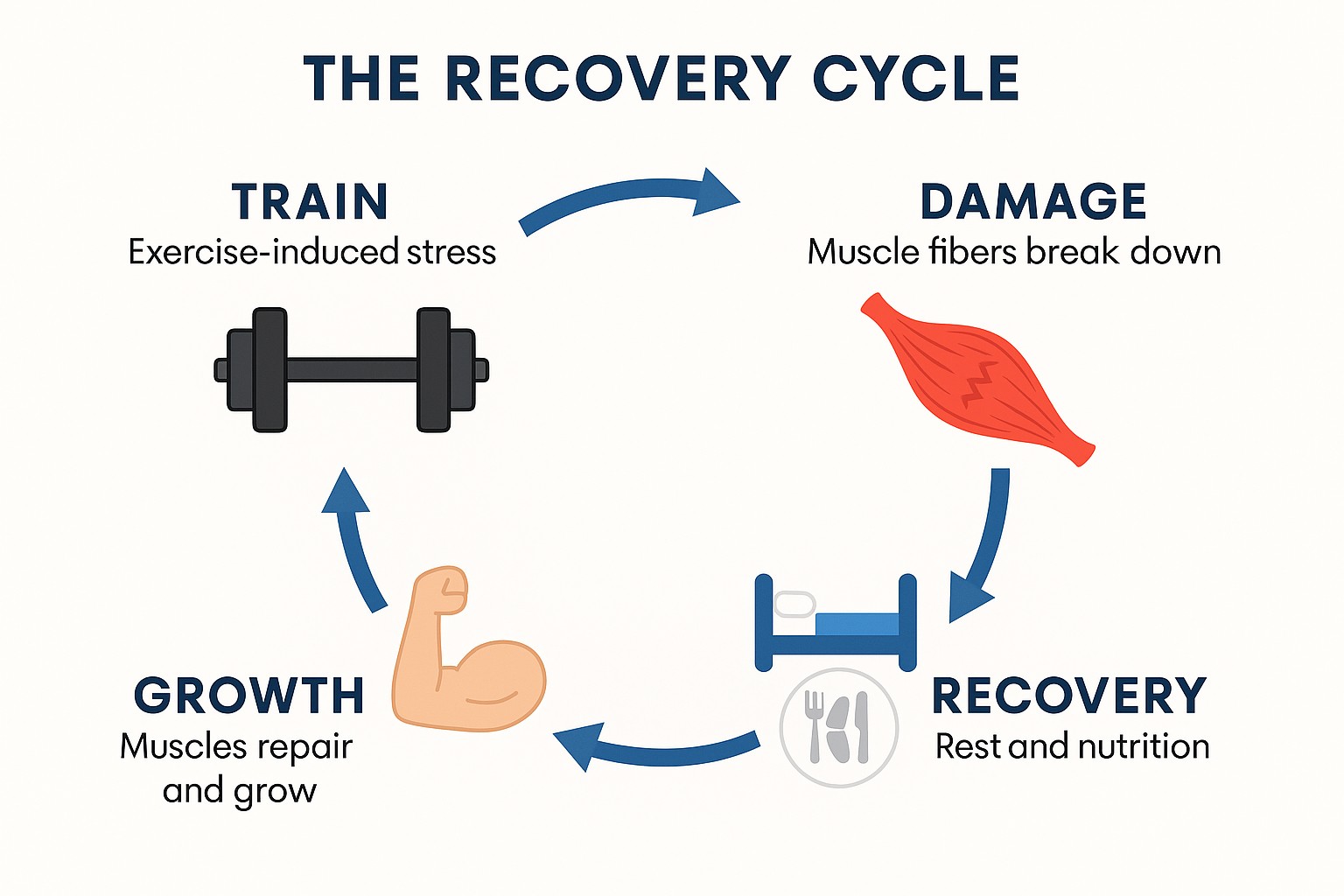
Many lifters believe muscle is built purely through intense training. However, the real magic happens *outside* the gym. Rest and recovery aren’t just passive breaks — they are **active, essential phases** where your muscles repair, adapt, and grow stronger. Prioritizing recovery can be the missing link that transforms hard training into real gains.
## Why Rest & Recovery Are Crucial
It’s easy to equate progress with lifting heavier weights or pushing through fatigue. But your body’s most important adaptations occur after training.
Think of your muscles like a construction project:
* **During training** you are the demolition crew — breaking down fibers, depleting energy, and signaling adaptation.
* **During recovery** the builders arrive — repairing fibers, replenishing stores, and reinforcing the foundation.
Without recovery, training becomes nothing more than controlled destruction.
—
## What Is Muscle Growth (Hypertrophy)?
**Hypertrophy** is the scientific term for the increase in muscle cell size. This happens as a direct result of resistance training, provided recovery conditions (sleep, nutrition, and rest) are in place.
—
## The Recovery Process
Here’s what happens when you step away from the weights:
1. **Muscle Repair & Protein Synthesis**
* Amino acids repair and rebuild muscle fibers through **Muscle Protein Synthesis (MPS)**.
* Inflammation initially signals repair but must subside to allow growth.
2. **Glycogen Replenishment**
* Carbohydrates restore muscle glycogen, your main energy source.
3. **Hormonal Regulation**
* Sleep drives the release of Human Growth Hormone (HGH) and testosterone.
* Poor recovery raises cortisol, which breaks down muscle.
4. **CNS Recovery**
* Your nervous system needs rest to restore strength, coordination, and motivation.
5. **Psychological Recharge**
* Rest prevents burnout, mental fatigue, and lack of motivation.
—
## Under the Microscope: Biological Mechanisms
### Muscle Protein Synthesis (MPS)
* Resistance training creates micro-tears.
* The **mTOR pathway** activates, ribosomes build new proteins, and fibers grow stronger.
* Elevated MPS lasts 24–48 hours after training.
### Anabolic vs. Catabolic Balance
* **Catabolic state** (during training): breakdown of muscle and glycogen.
* **Anabolic state** (during recovery): rebuilding, glycogen restoration, and hormone release.
* Goal: keep your body in a *net anabolic state* over time.
### Key Biological Players
* **Satellite Cells** → Repair and donate nuclei to muscle fibers.
* **mTOR Pathway** → Master switch for protein synthesis.
* **IGF-1** → Stimulates protein synthesis and growth.
* **Cytokines** → Signal inflammation and repair.
**Supercompensation:** the process where your body adapts beyond baseline after recovery, becoming stronger and more resilient.
—
## The Hidden Costs of Skipping Recovery
* **Overtraining Syndrome (OTS):** chronic fatigue, hormonal dysfunction, and performance decline.
* **Injury Risk:** weakened tendons and ligaments make strains and tears more likely.
* **Hormonal Dysregulation:** low testosterone/HGH, high cortisol.
* **CNS Burnout:** loss of strength, power, and motivation.
**Note:** *Functional Overreaching (FOR)* is planned short-term overload followed by recovery (beneficial), while *Overtraining Syndrome* is unplanned, chronic stress with severe consequences.
—
## Your Recovery Toolkit
### 1. Prioritize Sleep
* Aim for **7–9 hours** per night.
* Deep sleep releases HGH and testosterone.
* Sleep resets your nervous system and boosts recovery.
### 2. Strategic Nutrition
* **Protein:** 1.6–2.2 g/kg bodyweight daily.
* **Carbs:** Restore glycogen post-workout.
* **Healthy fats:** Support hormones.
* **Micronutrients:** Vitamins, minerals, and antioxidants support repair.
3. Active vs. Passive Recovery
| Feature | Active Recovery | Passive Recovery |
|---|---|---|
| Definition | Light, low-intensity exercise | Full rest or very light activity |
| Benefits | Improves circulation, reduces soreness, clears waste | Complete energy restoration |
| Examples | Walking, cycling, yoga, foam rolling | Napping, meditation, TV |
| When to Use | Off-days, post-workout | After very intense sessions or illness |
### 4. Stress & Mindset
* Mindfulness, hobbies, and deep breathing reduce cortisol.
* Social connection boosts mental recovery.
### 5. Key Recovery Tools
* **Deload Weeks** → Planned training breaks.
* **Hydration** → Optimizes nutrient transport.
* **Cold Therapy** → Reduces soreness and inflammation.
* **Foam Rolling** → Improves mobility and circulation.
—
## Listening to Your Body
Recovery is highly individual. Pay attention to:
* Persistent soreness
* Dropping performance
* Fatigue and sleep issues
* Mood swings or irritability
* Frequent illness or elevated heart rate
Adjust training, nutrition, and recovery time accordingly.
—
## Integrating Recovery for Peak Performance
Think of recovery as the **other half of training**:
* **Sleep + Nutrition = The Anabolic Power Couple**
* **Active Recovery + CNS Restoration = High-Quality Training Output**
* **Stress Management + Hydration = Long-Term Sustainability**
Recovery isn’t passive downtime — it’s the fuel that makes training productive.
—
## Final Takeaway
The gym breaks you down. Recovery builds you up.
Embrace recovery as a **strategic weapon**, not an afterthought. Train hard, recover harder, and watch your strength, size, and performance skyrocket.
—
Recommended Reading
How to Calculate Your Macronutrient Needs
How to Calculate Your Macronutrient Needs Unlock the secret to personalized nutrition! This comprehensive guide will demystify macronutrients (protein, carbs, and fats) and walk you through the exact calculations needed to determine your ideal daily intake. Whether you’re aiming for weight loss, muscle gain, or simply better health, you’ll leave with a practical framework to […]
Compound Exercises vs Isolation Exercises
Compound Exercises vs. Isolation Exercises: A Head-to-Head Comparison Unlock your full potential by strategically combining the power of compound movements with the precision of isolation exercises. Both have unique benefits, and understanding when and how to integrate each into your routine is the secret to maximizing strength, muscle growth, and overall fitness efficiently. Compound vs. […]
Bicep Training for Beginners: A Step-by-Step Program Ready to build stronger, more defined biceps but don’t know where to start? This beginner-friendly guide cuts through the confusion, providing a clear, step-by-step program to kickstart your bicep training journey. Learn the essentials, master foundational movements, and develop the confidence to sculpt impressive arms safely […]
The Beginners Guide to Hypertrophy
The Beginner’s Guide to Hypertrophy: Building Muscle from Scratch Unlock your muscle-building potential! Hypertrophy isn’t just for pros; it’s a science-backed process accessible to anyone starting from scratch. This guide will equip you with the fundamental knowledge to efficiently stimulate muscle growth, transforming your physique and strength faster than you might think. What Exactly […]
Leave a Reply