
50 High-Protein Foods for Muscle Growth Ranked by Protein per Calorie
50 High-Protein Foods for Muscle Growth, Ranked by Protein per Calorie
You know protein matters for building muscle.
The harder question is:
Which foods give you the most protein without forcing you to eat far more calories than your goal allows?
Some foods are extremely protein-dense.
Others provide valuable protein but also contain more carbohydrates or fat.
Neither category is automatically better.
A lean protein may be ideal during fat loss, while a higher-calorie protein can be useful for a hardgainer struggling to eat enough.
This guide ranks 50 common foods according to their approximate protein per 100 calories, helping you compare how efficiently each food contributes to your daily protein target.
You will also learn:
- Which foods offer the most protein per calorie
- The best animal and plant-based protein sources
- Which foods are complete proteins
- How much protein you need for muscle growth
- How to build high-protein meals
- Why the top-ranked food is not always the best choice
The International Society of Sports Nutrition recommends approximately 1.4–2.0 grams of protein per kilogram of body weight per day for most exercising people, with individual needs varying according to goals, training, age, and calorie intake. A serving of roughly 20–40 grams of high-quality protein is a useful target for many meals.
20 Best High-Protein Foods for Muscle Growth at a Glance
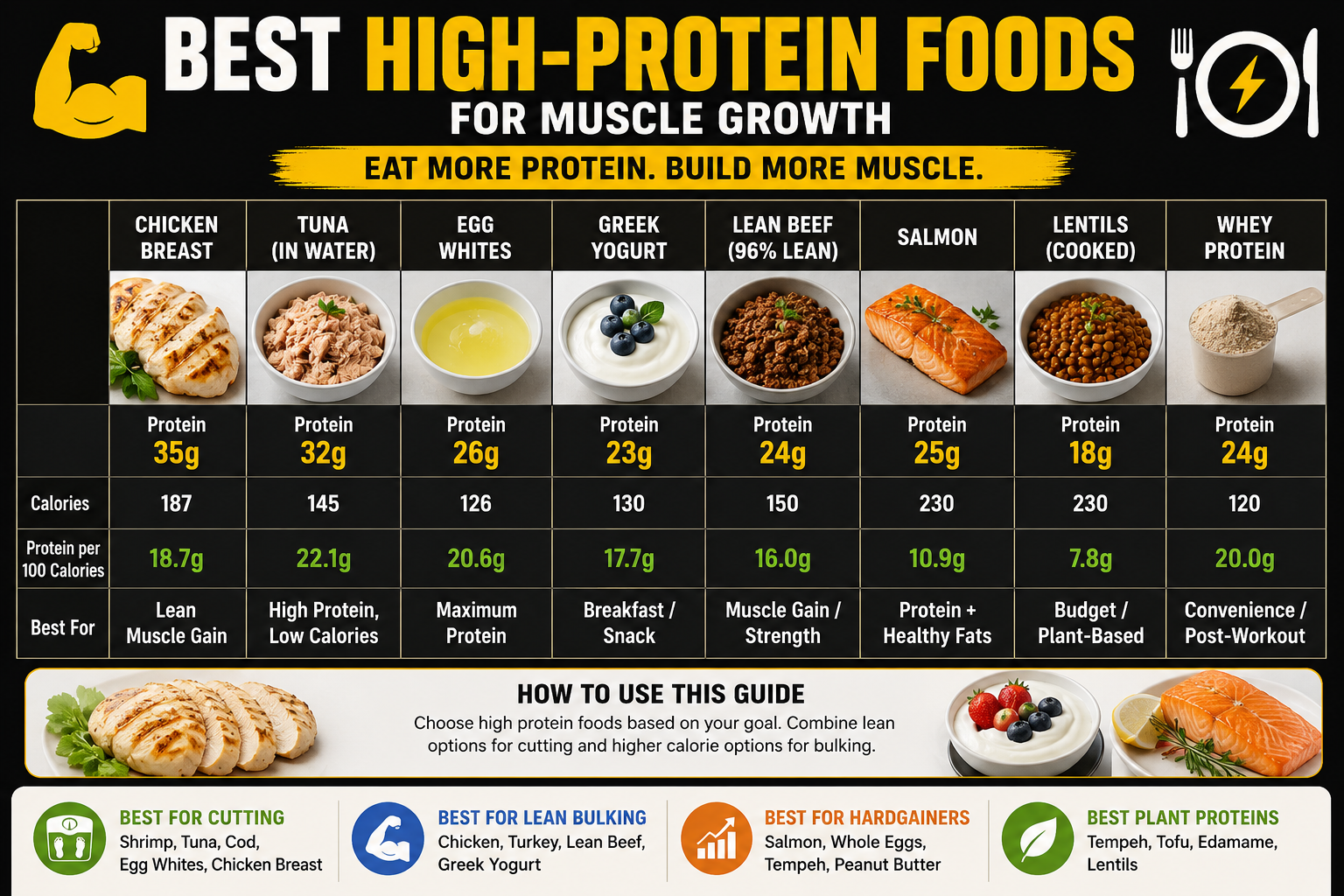
Protein per 100 calories shows how protein-dense each food is. Foods such as shrimp, tuna, cod, egg whites, and whey provide a lot of protein without many calories, making them especially useful when trying to build or maintain muscle while controlling calorie intake. Higher-calorie options such as salmon, whole eggs, tempeh, and peanut butter can be useful when you need more calories for a bulk.
| Food | Protein | Calories | Protein per 100 Calories | Best For |
|---|---|---|---|---|
| Chicken breast, cooked (4 oz) | 35g | 187 | 18.7g | Lean muscle gain |
| Tuna in water (1 can, drained) | 32g | 145 | 22.1g | High protein, low calories |
| Shrimp, cooked (4 oz) | 27g | 120 | 22.5g | Cutting / lean protein |
| Turkey breast, cooked (4 oz) | 32g | 170 | 18.8g | Lean bulking |
| Cod, cooked (4 oz) | 26g | 120 | 21.7g | Cutting |
| Egg whites (1 cup) | 26g | 126 | 20.6g | Maximum protein per calorie |
| Nonfat Greek yogurt (1 cup) | 23g | 130 | 17.7g | Breakfast / snack |
| Whey protein (1 scoop) | 24g | 120 | 20.0g | Convenience / post-workout |
| Lean ground turkey, cooked (4 oz) | 27g | 170 | 15.9g | Meal prep |
| 96% lean ground beef (4 oz) | 24g | 150 | 16.0g | Muscle gain / iron |
| Sirloin steak (4 oz) | 29g | 210 | 13.8g | Bulking / strength diets |
| Salmon, cooked (4 oz) | 25g | 230 | 10.9g | Protein + omega-3 fats |
| Low-fat cottage cheese (1 cup) | 28g | 180 | 15.6g | Snack / before bed |
| Whole eggs (3 large) | 19g | 216 | 8.8g | Breakfast / bulking |
| Tempeh (1 cup) | 31g | 320 | 9.7g | Plant-based muscle gain |
| Extra-firm tofu (1 cup) | 24g | 180 | 13.3g | Plant-based protein |
| Lentils, cooked (1 cup) | 18g | 230 | 7.8g | Budget / plant-based |
| Edamame, cooked (1 cup) | 18g | 190 | 9.5g | Plant-based snack |
| Black beans, cooked (1 cup) | 15g | 227 | 6.6g | Budget meals |
| Peanut butter (2 tbsp) | 8g | 190 | 4.2g | High-calorie bulking |
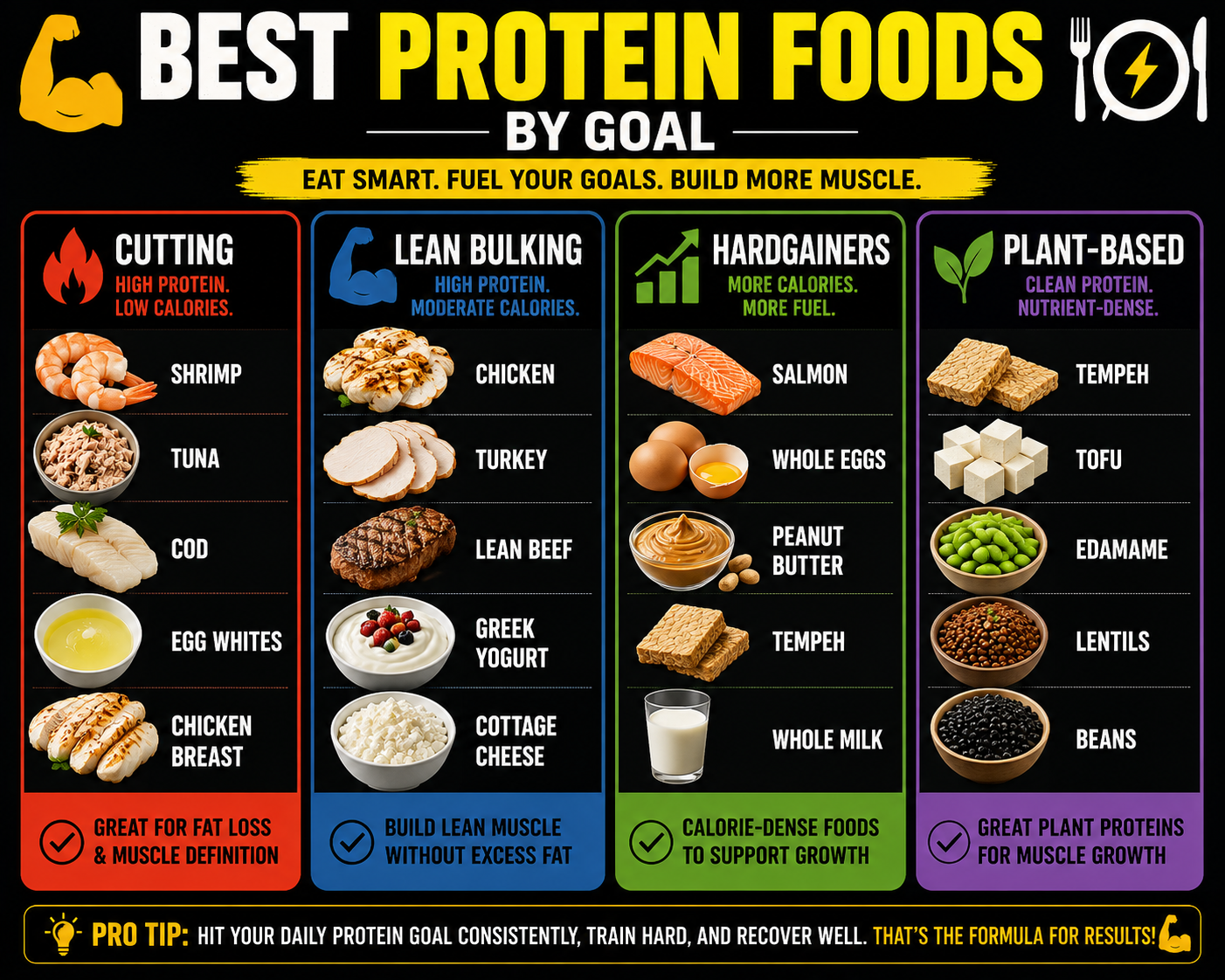
🔥 Best for cutting: Shrimp, tuna, cod, egg whites, chicken breast
💪 Best for lean bulking: Chicken, turkey, lean beef, Greek yogurt
📈 Best for hardgainers: Salmon, whole eggs, tempeh, peanut butter
🌱 Best plant proteins: Tempeh, tofu, edamame, lentils
How the Foods Were Ranked
The foods below are ranked by their approximate grams of protein per 100 calories.
The basic calculation is:
Protein per 100 calories = grams of protein ÷ calories × 100
For example, a cooked chicken breast containing approximately 31 grams of protein and 165 calories per 100 grams provides:
About 18.8 grams of protein per 100 calories
Nutritional estimates are based on typical plain-food entries and common serving preparations found in USDA FoodData Central. Actual values vary by brand, species, cut, fat percentage, water content, serving size, and cooking method.
Added oil, breading, sugar, sauces, and marinades can substantially lower a food’s protein-to-calorie ratio.
Use the rankings as a practical comparison—not as laboratory-precise numbers.
Which Foods Give You the Most Protein for the Fewest Calories?
🥇 Shrimp — 22.5g
🥈 Tuna — 22.1g
🥉 Cod — 21.7g
Egg Whites — 20.6g
Whey — 20.0g
Turkey — 18.8g
Chicken — 18.7g
50 High-Protein Foods Ranked by Protein per 100 Calories
| Rank | Food | Approx. protein per 100 calories | Typical protein serving |
|---|---|---|---|
| 1 | Egg whites | 21 g | 18–26 g per cup |
| 2 | Cod | 20–23 g | 20–24 g per 3 oz |
| 3 | Haddock | 20–22 g | 20–24 g per 3 oz |
| 4 | Pollock | 20–22 g | 19–23 g per 3 oz |
| 5 | Tuna in water | 20–22 g | 20–30 g per can |
| 6 | Shrimp | 20–21 g | 20–24 g per 3 oz |
| 7 | Tilapia | 19–21 g | 21–23 g per 3 oz |
| 8 | Skinless turkey breast | 19–20 g | 24–27 g per 3 oz |
| 9 | Skinless chicken breast | 18–19 g | 24–31 g per serving |
| 10 | Nonfat Greek yogurt | 17–19 g | 15–25 g per container |
| 11 | Whey protein isolate | 17–19 g | 22–27 g per scoop |
| 12 | Crab meat | 17–19 g | 17–21 g per 3 oz |
| 13 | Scallops | 17–19 g | 17–20 g per 3 oz |
| 14 | Lobster | 17–18 g | 20–24 g per 3–4 oz |
| 15 | Fat-free cottage cheese | 16–18 g | 24–28 g per cup |
| 16 | Lean deli turkey | 16–18 g | 15–20 g per 3 oz |
| 17 | Canned chicken breast | 16–18 g | 20–25 g per serving |
| 18 | Seitan | 15–18 g | 20–25 g per 3 oz |
| 19 | Very lean ham | 15–17 g | 17–22 g per 3 oz |
| 20 | Buffalo or bison, lean | 15–17 g | 21–24 g per 3 oz |
| 21 | Pork tenderloin | 15–17 g | 22–24 g per 3 oz |
| 22 | Venison | 15–17 g | 22–26 g per 3 oz |
| 23 | 99% lean ground turkey | 15–17 g | 24–27 g per 4 oz |
| 24 | 96% lean ground beef | 14–16 g | 22–25 g per 4 oz |
| 25 | Canadian bacon | 14–16 g | 12–16 g per serving |
| 26 | Low-fat cottage cheese | 14–16 g | 23–28 g per cup |
| 27 | Skyr | 14–16 g | 15–20 g per container |
| 28 | Nonfat plain yogurt | 12–15 g | 10–15 g per cup |
| 29 | Sirloin steak, trimmed | 12–14 g | 23–26 g per 3 oz |
| 30 | Roast beef, lean | 12–14 g | 20–24 g per 3 oz |
| 31 | Whey protein concentrate | 12–14 g | 20–25 g per scoop |
| 32 | Tempeh | 10–12 g | 16–20 g per 3–4 oz |
| 33 | Firm tofu | 10–12 g | 15–22 g per cup |
| 34 | Whole eggs | 9–11 g | 12–13 g per 2 eggs |
| 35 | Light mozzarella | 9–11 g | 7–9 g per ounce |
| 36 | Low-fat milk | 8–10 g | 8 g per cup |
| 37 | Soy milk, unsweetened | 8–10 g | 7–9 g per cup |
| 38 | Edamame | 8–10 g | 17–19 g per cooked cup |
| 39 | Lentils | 7–9 g | 17–18 g per cooked cup |
| 40 | Black beans | 6–8 g | 14–16 g per cooked cup |
| 41 | Kidney beans | 6–8 g | 14–16 g per cooked cup |
| 42 | Chickpeas | 5–7 g | 14–15 g per cooked cup |
| 43 | Green peas | 5–7 g | 8–9 g per cooked cup |
| 44 | Quinoa | 4–6 g | 8 g per cooked cup |
| 45 | Oatmeal | 4–5 g | 5–6 g per cooked cup |
| 46 | Peanut powder | 4–6 g | 6–8 g per serving |
| 47 | Peanuts | 4–5 g | 7 g per ounce |
| 48 | Almonds | 3–4 g | 6 g per ounce |
| 49 | Pumpkin seeds | 3–4 g | 8–9 g per ounce |
| 50 | Peanut butter | 3–4 g | 7–8 g per 2 tablespoons |
1. Egg Whites
Egg whites rank near the top because they contain almost no fat and very few carbohydrates.
A large egg white provides roughly:
- 3–4 grams of protein
- 15–20 calories
They are useful for increasing the protein content of a meal without adding many calories.
Muscle-building meal idea
Combine:
- One or two whole eggs
- Several egg whites
- Oatmeal
- Fruit
Whole eggs add flavor, dietary fat, vitamins, and minerals, while the egg whites increase the total protein.
2–4. Lean White Fish
Cod, haddock, and pollock are among the most protein-dense whole foods.
They are typically:
- High in complete protein
- Low in fat
- Low in calories
- Easy to combine with rice, potatoes, or vegetables
These fish are excellent during:
- Fat-loss phases
- Body recomposition
- High-protein meal planning
- Lower-calorie diets
Because they are lean, they may be less filling calorie-for-calorie than fatty fish for some people. Add potatoes, rice, olive oil, or avocado according to your goals.
5. Tuna in Water
Water-packed tuna is inexpensive, portable, and protein-dense.
A common can provides approximately 20–30 grams of protein, depending on brand and drained weight. One commercial example provides 20 grams of protein for 90 calories.
Easy ways to use it
- Tuna and Greek-yogurt salad
- Tuna sandwich
- Tuna rice bowl
- Tuna with crackers and vegetables
Avoid relying on tuna as your only fish source. Rotate it with salmon, sardines, shrimp, cod, and other seafood.
6. Shrimp
Shrimp provides approximately 20 grams of protein per typical three-ounce serving with relatively few calories.
It works well in:
- Stir-fries
- Rice bowls
- Pasta dishes
- Tacos
- Salads
Be mindful of added butter, frying oil, breading, and sugary sauces. These can turn a lean protein into a much higher-calorie meal.
7. Tilapia
Tilapia is another lean, mild-flavored fish with a favorable protein-to-calorie ratio.
It is usually affordable and easy to prepare.
Try it with:
- Potatoes and vegetables
- Rice and salsa
- Tacos with cabbage
- Quinoa and salad
8–9. Turkey and Chicken Breast
Skinless poultry breast is a bodybuilding staple for good reason.
Cooked chicken breast provides roughly 31 grams of protein and 165 calories per 100 grams in a commonly referenced USDA entry.
Poultry breast is:
- High in complete protein
- Relatively low in fat
- Easy to meal prep
- Versatile
- Widely available
Keep it interesting
Use different seasonings and cooking styles:
- Garlic and herb
- Taco seasoning
- Curry
- Lemon pepper
- Teriyaki-style sauce
- Smoked paprika
The protein content matters, but adherence matters too. You are more likely to maintain a high-protein diet when the food tastes good.
10. Nonfat Greek Yogurt
Nonfat Greek yogurt is one of the best high-protein breakfast and snack options.
Typical plain versions provide roughly:
- 15–25 grams of protein per serving
- Relatively few calories
- Calcium
- A mixture of whey and casein proteins
USDA FoodData Central contains entries for plain nonfat Greek yogurt, although values vary among products.
Muscle-building snack
Combine:
- Greek yogurt
- Berries
- Oats or granola
- Honey if additional carbohydrates are needed
Choose plain or lower-sugar products when controlling calories.
11. Whey Protein Isolate
Whey isolate is not a whole food, but it is one of the most protein-dense options available.
A typical scoop contains:
- 22–27 grams of protein
- Approximately 100–130 calories
- Very little fat or lactose
It is useful when:
- You have little appetite
- You need a portable protein source
- You train early in the morning
- Your whole-food meals fall short of your target
Protein powder is a convenience—not a requirement.
12–14. Crab, Scallops, and Lobster
Shellfish can provide large amounts of protein with relatively few calories.
They also contribute nutrients such as:
- Vitamin B12
- Selenium
- Zinc
- Iodine
The main issue is often preparation.
Steamed lobster is lean.
Lobster covered in butter is much less protein-efficient.
The same principle applies to fried crab cakes and breaded scallops.
15–17. Fat-Free Cottage Cheese, Deli Turkey, and Canned Chicken
These are convenient options for people who do not have time to cook every meal.
Fat-free cottage cheese
Useful as:
- A snack
- A breakfast
- A pre-sleep protein source
- A base for savory bowls
Deli turkey
Useful for:
- Sandwiches
- Wraps
- Quick snacks
Choose lower-sodium options when possible, especially if processed meats make up a large part of your diet.
Canned chicken
Useful for:
- Salads
- Wraps
- Rice bowls
- High-protein dips
18. Seitan
Seitan is made primarily from wheat gluten.
It is one of the most protein-dense plant-based foods.
A typical serving can provide approximately 20–25 grams of protein with relatively few calories.
However, seitan:
- Is unsuitable for people with celiac disease or gluten intolerance
- Is relatively low in lysine compared with some other proteins
- Is best combined with a varied plant-based diet
Pair it with beans, lentils, soy foods, or other protein sources across the day.
19–25. Lean Meat Options
Very lean ham, bison, pork tenderloin, venison, extra-lean turkey, extra-lean beef, and Canadian bacon all provide substantial protein.
Advantages
- Complete amino-acid profiles
- Iron
- Zinc
- Vitamin B12
- Easy meal preparation
Considerations
Processed meats such as ham, deli meat, and Canadian bacon can be high in sodium and should not displace minimally processed foods.
Lean red meat can fit into a balanced diet, but variety remains important.
Rotate among:
- Poultry
- Fish
- Dairy
- Eggs
- Beans
- Soy foods
- Lean red meat
26–28. Cottage Cheese, Skyr, and Yogurt
These foods provide a combination of:
- High-quality protein
- Calcium
- Convenient serving sizes
- Easy meal preparation
Skyr and Greek yogurt are generally more protein-dense than ordinary yogurt because of their straining and processing methods.
Plain versions allow you to control added sugar.
Recent dietitian recommendations also commonly highlight cottage cheese, tofu, strained yogurt, lentils, and kefir as affordable alternatives to protein powder.
29–31. Lean Beef and Whey Concentrate
Sirloin and roast beef
Lean cuts provide complete protein along with iron, zinc, creatine, and vitamin B12.
Their protein-to-calorie ratio is lower than chicken breast because they generally contain more fat.
That does not make them inferior.
The additional calories can be useful during a muscle-building phase.
Whey concentrate
Whey concentrate usually contains slightly more carbohydrate and fat than isolate, but it is often less expensive.
For most people, the practical difference between concentrate and isolate is small.
Choose based on:
- Budget
- Digestion
- Lactose tolerance
- Taste
32–33. Tempeh and Tofu
Soy foods are among the strongest plant-based options for muscle-building diets.
Tempeh
Tempeh is fermented and usually firmer and more calorie-dense than tofu.
It works well in:
- Stir-fries
- Sandwiches
- Grain bowls
- Salads
Tofu
Tofu is highly versatile and can be:
- Scrambled
- Baked
- Air-fried
- Blended into sauces
- Added to soups
Soy protein contains all nine essential amino acids.
Plant-based lifters can build muscle successfully when they consume enough total protein and calories.
34. Whole Eggs
Whole eggs rank lower than egg whites because the yolk adds fat and calories.
That does not mean the yolk should be avoided.
Whole eggs provide:
- Complete protein
- Choline
- Vitamin B12
- Selenium
- Dietary fat
- Fat-soluble nutrients
A useful strategy is combining whole eggs with additional whites.
Example:
- Two whole eggs
- Four egg whites
This gives you the nutrients and flavor of yolks while increasing the total protein.
35–37. Light Cheese, Milk, and Soy Milk
These foods are not as protein-dense as lean meat or fish, but they are easy ways to raise the protein content of meals.
Light mozzarella
Use it in:
- Omelets
- Sandwiches
- Wraps
- Pizza-style meals
Low-fat milk
Provides approximately eight grams of protein per cup.
Use it in:
- Smoothies
- Oatmeal
- Cereal
- Protein shakes
Unsweetened soy milk
One of the closest plant-based alternatives to dairy milk in protein content.
Check the label because almond, rice, oat, and coconut beverages often contain much less protein.
38–43. Edamame, Lentils, Beans, Chickpeas, and Peas
Legumes rank lower per calorie than lean animal proteins because they also contain carbohydrates.
However, they offer important advantages:
- Fiber
- Folate
- Potassium
- Iron
- Slow-digesting carbohydrates
- Improved meal fullness
A cup of cooked lentils provides roughly 18 grams of protein plus substantial fiber.
Easy high-protein combinations
- Lentils with chicken
- Beans with lean beef
- Chickpeas with tuna
- Edamame with tofu
- Lentil pasta with turkey sauce
You do not have to choose between animal and plant proteins.
Combining them can improve variety and nutrient intake.
44–45. Quinoa and Oatmeal
Quinoa and oatmeal are often called high-protein foods, but they are primarily carbohydrate sources.
They contribute useful protein, but you would need a large number of calories to reach a full muscle-building protein target using them alone.
Treat them as protein-supporting foods.
Improve oatmeal
Add:
- Greek yogurt
- Milk
- Protein powder
- Egg whites
- Peanut powder
Improve quinoa
Combine it with:
- Chicken
- Fish
- Tofu
- Beans
- Lean beef
46. Peanut Powder
Powdered peanut products remove much of the natural fat found in peanuts.
This improves the protein-to-calorie ratio.
Use peanut powder in:
- Smoothies
- Greek yogurt
- Oatmeal
- Sauces
- Protein desserts
Check the label for added sugar.
47–50. Nuts, Seeds, and Peanut Butter
Nuts and nut butters are nutritious, but they are often incorrectly described as primary protein foods.
They contain protein, but most of their calories come from fat.
For example, peanut butter may provide seven or eight grams of protein for nearly 200 calories.
That can be useful for:
- Hardgainers
- Bulking diets
- Calorie-dense snacks
- Adding healthy fats
It is less efficient for someone trying to maximize protein while maintaining a strict calorie deficit.
Use nuts and seeds primarily as sources of:
- Healthy fats
- Minerals
- Fiber
- Additional protein
rather than as your main protein source.
Best High-Protein Foods for Fat Loss
During fat loss, choose foods that provide substantial protein and help manage calories.
Strong options include:
- Egg whites
- Cod
- Tuna in water
- Shrimp
- Chicken breast
- Turkey breast
- Nonfat Greek yogurt
- Low-fat cottage cheese
- Extra-lean ground meat
- Tofu
- White fish
These foods make it easier to maintain protein while creating a calorie deficit.
Best High-Protein Foods for Bulking
During a bulk, protein per calorie is not your only priority.
You may need foods that provide protein and enough energy to support weight gain.
Useful options include:
- Whole eggs
- Salmon
- Lean or moderate-fat beef
- Whole or 2% milk
- Greek yogurt
- Cottage cheese
- Tempeh
- Nuts
- Peanut butter
- Protein smoothies
A hardgainer may find peanut butter more useful than egg whites because the additional calories make it easier to reach a surplus.
Best Budget High-Protein Foods
Protein does not need to be expensive.
Affordable options frequently include:
- Eggs
- Canned tuna
- Canned chicken
- Chicken thighs
- Milk
- Cottage cheese
- Greek yogurt in large containers
- Lentils
- Black beans
- Chickpeas
- Tofu
- Peanut powder
- Whey concentrate
Prices vary by location, sales, and package size.
Compare the cost per 20 or 25 grams of protein rather than only the package price.
Best Vegetarian High-Protein Foods
Vegetarians can use:
- Greek yogurt
- Cottage cheese
- Eggs
- Milk
- Skyr
- Whey protein
- Tofu
- Tempeh
- Edamame
- Lentils
- Beans
- Seitan
Vegans can use:
- Seitan
- Tofu
- Tempeh
- Edamame
- Soy milk
- Lentils
- Beans
- Chickpeas
- Pea or soy protein powder
A varied diet helps provide a complete distribution of essential amino acids.
Complete vs. Incomplete Protein
A complete protein contains all nine essential amino acids in adequate proportions.
Complete proteins include:
- Meat
- Fish
- Eggs
- Dairy
- Soy
- Quinoa
- Many protein powders
Some plant proteins contain lower proportions of one or more essential amino acids.
You do not need to combine incomplete proteins at every meal.
Eating a varied diet across the day is generally sufficient.
Useful combinations include:
- Rice and beans
- Lentils and whole grains
- Peanut butter and bread
- Hummus and pita
How Much Protein Do You Need to Build Muscle?
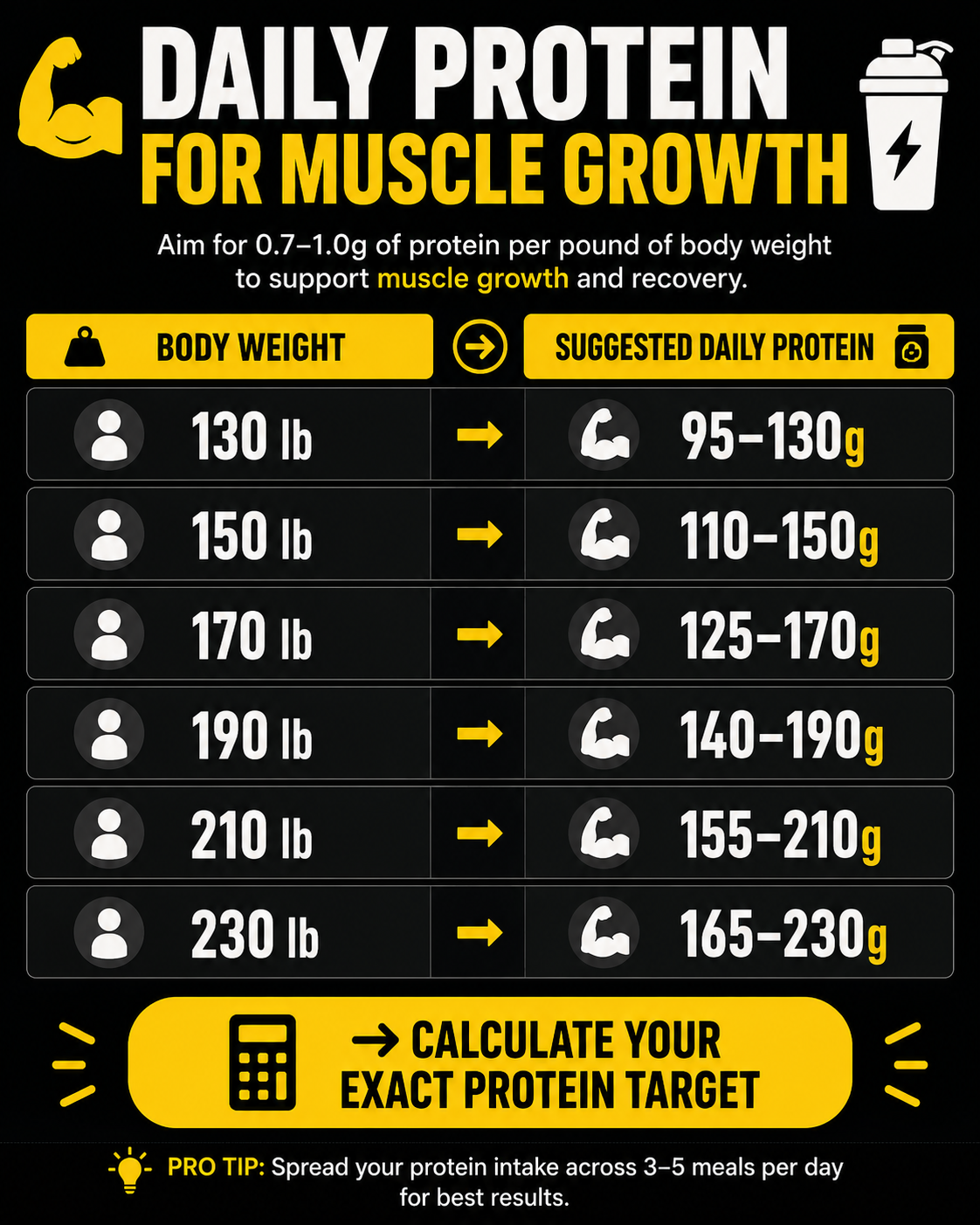
A practical range for most resistance-trained adults is:
1.6–2.2 grams of protein per kilogram of body weight per day
The lower end may be enough for many people eating at maintenance or in a surplus.
The higher end can be useful when:
- Dieting
- Training at high volume
- Older
- Using mostly plant proteins
- Trying to maximize muscle retention
The ISSN’s broader evidence-based range of approximately 1.4–2.0 grams per kilogram is sufficient for most exercising people.
Example targets
| Body weight | Approximate daily target |
|---|---|
| 120 lb | 87–120 g |
| 140 lb | 102–140 g |
| 160 lb | 116–160 g |
| 180 lb | 131–180 g |
| 200 lb | 145–200 g |
| 220 lb | 160–220 g |
You do not need to hit the maximum number every day to make progress.
Consistency within an appropriate range matters more.
How Much Protein Should You Eat Per Meal?
A practical target is:
20–40 grams per meal
Larger individuals and older adults may benefit from the upper end.
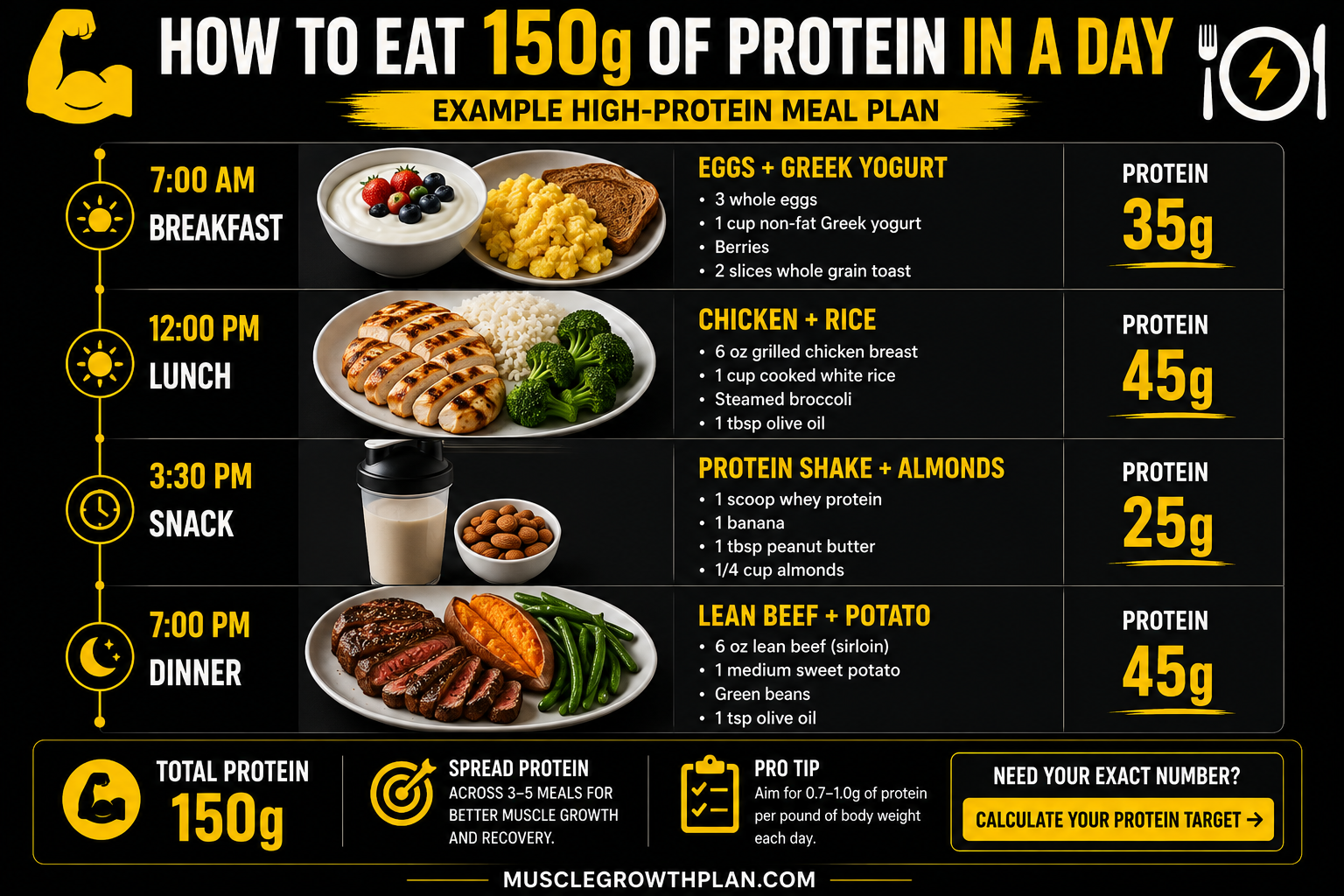
Instead of consuming almost all your protein at dinner, distribute it across three to five meals.
Example 160-gram day
Breakfast
40 grams
Lunch
40 grams
Post-workout meal
40 grams
Dinner
40 grams
An exact four-way distribution is not mandatory, but spreading intake makes the daily target easier to reach.
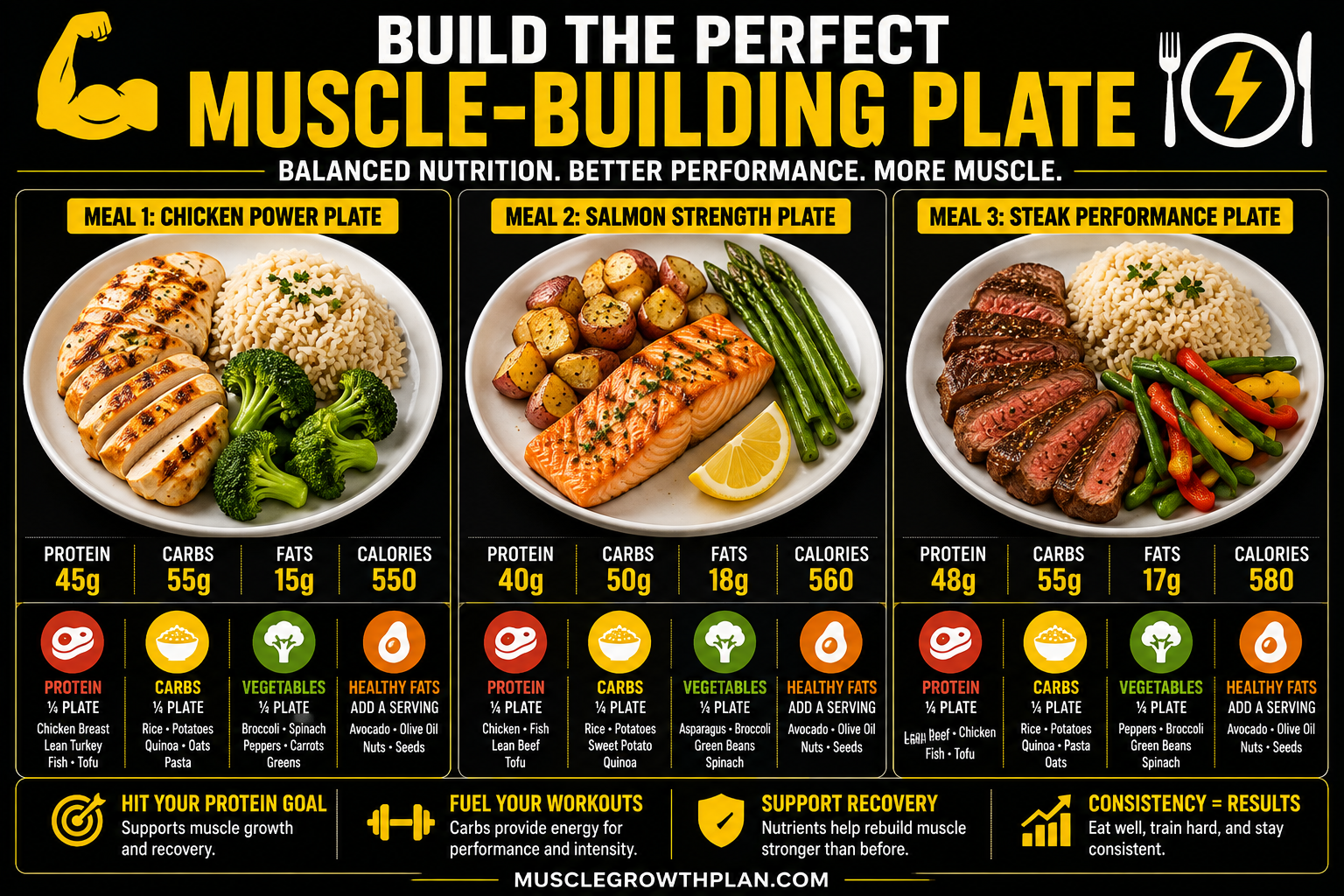
How to Build a High-Protein Meal
Use this simple formula:
Step 1: Choose a main protein
Examples:
- Chicken
- Fish
- Eggs
- Beef
- Greek yogurt
- Tofu
- Lentils
Step 2: Add a carbohydrate
Examples:
- Rice
- Potatoes
- Oats
- Pasta
- Fruit
- Beans
Step 3: Add vegetables or fruit
This improves fiber, vitamins, minerals, and fullness.
Step 4: Add fat according to your calorie goal
Examples:
- Olive oil
- Avocado
- Nuts
- Cheese
- Peanut butter
Someone cutting may use less added fat.
Someone bulking may use more.
Sample High-Protein Day
Breakfast
- Two whole eggs
- Egg whites
- Oatmeal
- Berries
Approximate protein: 35–40 grams
Lunch
- Chicken breast
- Rice
- Vegetables
Approximate protein: 40–50 grams
Snack
- Nonfat Greek yogurt
- Fruit
- Peanut powder
Approximate protein: 25–35 grams
Dinner
- Salmon, lean beef, or tofu
- Potatoes
- Salad
Approximate protein: 35–45 grams
Evening snack
- Cottage cheese
Approximate protein: 20–25 grams
Common High-Protein Diet Mistakes
Mistake 1: Choosing foods based only on protein per calorie
Food quality, enjoyment, cost, nutrients, and your calorie goal also matter.
Mistake 2: Treating nuts as the main protein
Nuts are healthy, but they are primarily fat sources.
Mistake 3: Ignoring calories in sauces and cooking oils
A lean food can become calorie-dense after frying or adding heavy sauces.
Mistake 4: Eating no fruits, vegetables, or fiber
A muscle-building diet should still support overall health.
Mistake 5: Relying entirely on protein powder
Use powder for convenience, not as a replacement for every meal.
Mistake 6: Assuming more protein always produces more muscle
Once adequate intake is reached, extra protein cannot compensate for poor training or insufficient recovery.
Mistake 7: Ignoring total calories
You still need enough energy to support training and growth.
Frequently Asked Questions
What food has the most protein per calorie?
Egg whites, lean white fish, water-packed tuna, shrimp, and skinless poultry breast are among the highest-protein foods per calorie.
Is chicken the best food for muscle growth?
Chicken is an excellent protein source, but it is not uniquely superior. Fish, dairy, eggs, lean meat, soy foods, and legumes can all contribute to muscle growth.
Are eggs good for building muscle?
Yes. Whole eggs provide complete protein and several useful nutrients. Egg whites can be added when you want more protein with fewer calories.
Can plant foods provide enough protein?
Yes. Use tofu, tempeh, seitan, lentils, beans, edamame, soy milk, and plant-based protein powders. Total intake and dietary variety matter.
Is protein powder necessary?
No. It is simply a convenient way to increase protein intake.
Which protein foods are best before a workout?
Choose easily digested options such as Greek yogurt, whey protein, eggs, turkey, or a light chicken meal alongside carbohydrates.
Which protein foods are best after a workout?
Chicken, fish, lean beef, eggs, Greek yogurt, cottage cheese, tofu, and protein shakes can all work. The most important factor is meeting your total daily target.
Are higher-calorie protein foods bad?
No. Salmon, whole eggs, nuts, and peanut butter provide useful nutrients and can be excellent during a muscle-building phase. They are simply less protein-dense per calorie.
Final Thoughts
The best muscle-building diet is not made from one perfect protein source.
It uses a variety of foods that help you meet your protein target while supporting your calorie needs, preferences, budget, and health.
For maximum protein with fewer calories, prioritize:
- Egg whites
- Lean fish
- Tuna in water
- Shrimp
- Chicken breast
- Turkey breast
- Nonfat Greek yogurt
- Low-fat cottage cheese
For additional calories during a bulk, include:
- Whole eggs
- Salmon
- Lean beef
- Milk
- Tempeh
- Nuts
- Peanut butter
- Higher-calorie smoothies
Remember:
- Eat approximately 1.6–2.2 grams of protein per kilogram when muscle growth is the goal.
- Spread protein across several meals.
- Include complete and varied protein sources.
- Match food choices to your calorie goal.
- Continue training with progressive overload.
- Sleep and recover consistently.
Protein provides the building materials.
Your training provides the reason for your body to use them.
Ready to Build Your Muscle-Growth Diet?
Download our FREE High-Protein Muscle-Building Meal Plan and receive:
- Seven days of meals
- Protein targets for different body weights
- A complete grocery list
- Budget-friendly substitutions
- Vegetarian options
- Pre- and post-workout meal ideas
Stop guessing how to reach your protein target and start building meals you can follow consistently.
Question: Which high-protein food do you eat most often—chicken, fish, eggs, Greek yogurt, beef, or a plant-based option? Share your answer in the comments.**
Nutrition Disclaimer
This article provides general nutrition information and is not individualized medical advice. People with kidney disease, food allergies, digestive disorders, metabolic conditions, or other health concerns should consult a qualified healthcare professional or registered dietitian before substantially increasing protein intake.
- 3,000-Calorie Bulking Meal Plan for Muscle Growth
- How to Track Macros for Muscle Growth: Beginner’s Guide
- Best Leg Workout for Muscle Growth: Complete Lower-Body Program
- How Much Water Should You Drink to Build Muscle?
- How to Build a Mind-Muscle Connection for Better Muscle Growth
- 50 High-Protein Foods for Muscle Growth Ranked by Protein per Calorie
- Best 5-Day Workout Split for Muscle Growth
- How to Build Muscle at Home With No Equipment
- Best Shoulder Workout for Mass: Build Bigger, Wider Shoulders
- What Is a Deload Week? Benefits, Timing and How to Do One Properly
Leave a Reply