
5 Science-Backed Strategies for Rapid Glute Muscle Growth
Introduction: The Anatomy & Science of Rapid Glute Growth
Ready to sculpt powerful glutes at an accelerated pace? Beyond simply lifting heavy, true rapid growth demands precision in your execution and dedication to your recovery. Implement these quick, actionable strategies to ignite your glute development and see results faster than ever before.
Rapid glute muscle growth isn’t just about aesthetics; it’s about building power, improving athletic performance, and supporting overall body mechanics. To unlock your glute potential, you need a blueprint grounded in science and proven strategies.
Core concept—Hypertrophy:
Muscle growth occurs when individual muscle cells increase in size after strategic training stress. Effective glute training creates microscopic fiber damage; your body repairs and *overbuilds* those fibers so they come back thicker and stronger.
Key terms you’ll see:
Gluteal Muscles:
Gluteus maximus (largest and strongest), gluteus medius, and gluteus minimus—responsible for hip extension, abduction, and external rotation.
Progressive Overload:
Continuously increasing training demand via weight, reps, sets, range of motion (ROM), tempo, or rest.
Mind–Muscle Connection:
Actively contracting the target muscle (your glutes) during an exercise.
Time Under Tension (TUT):
How long the muscle works in a set—especially the slow, controlled lowering (eccentric).
–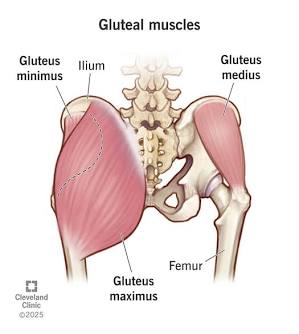
Anatomy of the primary gluteal muscles. Source: Cleveland Clinic
Achieving rapid glute muscle growth (hypertrophy) requires more than simply adding heavy squat sets to your leg routine. The gluteal complex consists of three primary muscles that demand targeted mechanical tension, high-yield exercise selection, and sufficient nutrient support to adapt and grow.
Understanding the Gluteal Muscle Group
-
Gluteus Maximus: The largest muscle in the human body, responsible for hip extension and external rotation. It provides the bulk of overall glute size.
-
Gluteus Medius: Positioned on the outer hip, responsible for hip abduction and pelvis stabilization during single-leg movements.
-
Gluteus Minimus: Located directly beneath the medius, assisting in abduction and internal hip rotation.
According to research published in the Journal of Strength and Conditioning Research, optimal hypertrophy occurs when muscles experience a combination of mechanical tension, muscle damage, and metabolic stress under a structured training volume (Schoenfeld, 2010).
Strategy 1: Apply Mechanical Tension Through Progressive Overload
6 Ways to Apply Progressive Overload to Glute Training
-
Increase Resistance: Gradually add weight to the bar (+2.5 to 5 lbs per week).
-
Increase Volume: Complete an extra rep or set while maintaining optimal execution form.
-
Optimize Range of Motion (ROM): Achieve full lockout on hip thrusts or deeper depth on Romanian Deadlifts (RDLs).
-
Control Eccentric Tempo: Slow down the lowering phase (2–3 seconds) to maximize time under tension.
-
Improve Mind-Muscle Connection: Focus on peak voluntary isometric contraction at the top of each repetition.
Strategy 2: Prioritize High-Yield Exercises & Biomechanical Angles
Not all lower-body exercises stimulate the glutes equally. Combining horizontal hip extension movements (like hip thrusts) with vertical loading patterns (like deep squats) ensures complete activation across all three gluteal heads.
Prioritize exercises that *actually* load your glutes—and make sure they’re awake before heavy work.
Effective 5–10 minute pre-activation (pick 2–3):
bodyweight glute bridges, banded clamshells, banded lateral walks.
Top-Tier Glute-Building Exercises (What, How, Why)
| Exercise | Primary Target | Stimulus Emphasis | Form Keys |
|---|---|---|---|
| Barbell Hip Thrust | Glute Max | Peak contraction (horizontal force) | Chin tucked, pelvis neutral, full lockout & squeeze. |
| Barbell Back Squat | Glute Max + quads/hamstrings | Stretch under load (vertical force) | Brace; sit hips back; controlled depth per mobility. |
| Romanian Deadlift (RDL) | Glute Max + hamstrings | Eccentric stretch loading | Hinge; shins near vertical; back neutral. |
| Bulgarian Split Squat | Glute Max/Med (unilateral) | Deep ROM, stability | Torso tall; long stride; drive through front heel. |
| Cable Kickback / Abduction | Max (kickback) / Med–Min (abduction) | Isolation + mind–muscle connection | Slow tempo; control pelvis; peak squeeze. |
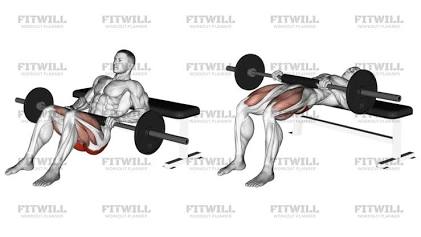
Barbell hip thrust execution for peak contraction. Source: Fitwill
Hip Thrusts vs. Squats: A Detailed Comparison
| Feature | Barbell Hip Thrust | Barbell Back Squat |
|---|---|---|
| Primary Glute Focus | Gluteus maximus at peak contraction; horizontal force | Gluteus maximus under stretch; vertical force |
| Glute Medius/Minimus | Moderate (stance width changes involvement) | Moderate (stance width changes involvement) |
| Overall Leg Involvement | Primarily glutes & hamstrings | Quads, hamstrings, glutes, calves, core |
| Load Potential | Very high (glute-focused loading) | High (full-body strength limiter) |
| Spinal Loading | Lower (load sits on hips) | Moderate–high (axial compression) |
| Functional Carryover | Explosive hip extension | Total strength & athletic transfer |
| Ease of Learning | Moderate (setup required) | Higher skill (bracing & mobility) |
—
Strategy 3: Fuel Hypertrophy with Evidence-Based Nutrition
Training initiates the stimulus for muscle growth, but nutritional intake dictates the magnitude of recovery and synthesis.
Caloric Surplus: +250–500 kcal/day above maintenance for most lifters.
Protein: 1.6–2.2 g/kg (≈0.7–1.0 g/lb) bodyweight daily, split 3–5 meals.
Carbohydrates: 3–5 g/kg (or 45–60% calories), anchor around training.
Fats: 20–30% of calories from quality sources.
Hydration & Micros: 3–4 L water/day; eat varied whole foods.
Macro Targets for Muscle Building
-
Protein Intake: Consume 1.6 to 2.2 grams per kilogram of bodyweight (0.7–1.0 g/lb) daily. Divide protein across 3 to 5 distinct meals to optimize muscle protein synthesis (MPS) rates (Morton et al., 2018).
-
Carbohydrate Timing: Carbohydrates replenish muscle glycogen stores and optimize performance. Ingest fast-digesting carbohydrates within 1 to 2 hours post-workout.
-
Dietary Fats: Keep fat intake between 20% and 30% of total daily calories to support endocrine and hormonal function.
Nutrition Macro Targets & Meal Timing (Quick Reference)
| Bodyweight | Daily Calories (Start Point) | Protein | Carbs | Fats | Meal Timing Tips |
|---|---|---|---|---|---|
| ~120 lb (54 kg) | Maintenance + 250–300 kcal | 85–120 g (0.7–1.0 g/lb) | 165–270 g (≈45–60% kcal) | 40–60 g (≈25–30% kcal) | 20–40 g protein in 3–5 meals; carbs pre (1–2 h) & post (≤2 h) workout. |
| ~150 lb (68 kg) | Maintenance + 300–400 kcal | 105–150 g | 205–340 g | 50–70 g | Keep post-workout protein 0.3 g/kg; add fast-digesting carbs. |
| ~180 lb (82 kg) | Maintenance + 350–500 kcal | 125–180 g | 245–410 g | 60–85 g | Evenly space protein; hydrate 500 ml 1–2 h pre-training. |
| ~210 lb (95 kg) | Maintenance + 400–550 kcal | 145–210 g | 285–470 g | 70–95 g | Limit super-high fat meals pre-lift (can blunt carbs’ uptake). |
Example Day (training at 5 pm):
Breakfast: Protein + complex carbs + fruit
Lunch: Protein + complex carbs + veg + fats
Pre (3 pm): Protein + carb (e.g., yogurt + granola, rice cakes + turkey)
Post (6:30 pm): Whey 20–40 g + fast/medium carb (banana, cereal, rice)
Dinner: Protein + starch + veg + healthy fat
Strategy 4: Optimize Training Frequency & Volume
Research indicates that training a muscle group 2 to 3 times per week produces superior hypertrophy compared to a single weekly session when total weekly volume is equalized (Schoenfeld et al., 2016).
-
Target Weekly Volume: Aim for 10 to 20 hard working sets per week (working within 1 to 3 repetitions in reserve / RIR).
-
Rest Periods: Allow 2 to 3 minutes of rest between heavy compound sets (e.g., hip thrusts, squats) to maintain high force output across sets.
Muscle protein synthesis (MPS) elevates \~24–48 hours post-session. Hitting glutes **2–3×/week** creates more frequent MPS spikes, with total weekly **10–20 hard sets** (near muscular failure, RPE \~7–9) as an effective range for most lifters.
Training Frequency: Low vs. High
| Feature | Lower Frequency (≈1×/week) | Higher Frequency (≈2–3×/week) |
|---|---|---|
| Muscle Protein Synthesis | Fewer, larger spikes; long gaps | More frequent spikes; steadier signal |
| Recovery Per Session | Needs longer (sessions are high-volume) | Shorter per session; total weekly recovery key |
| Skill Acquisition | Less practice of main lifts | More practice; technique improves faster |
| Fatigue Accumulation | Higher acute fatigue/soreness | Fatigue spread across the week |
| Hypertrophy Potential | Generally sub-optimal (when volume is equal) | Generally superior (when volume is equal) |
| Practicality | Fewer gym visits | More visits, shorter sessions |
Weekly Glute Training Blueprint (3-Day Split)
| Day | Focus | Activation (5–10 min) | Main Lifts (Sets × Reps) | Notes |
|---|---|---|---|---|
| Day 1 | Heavy Glute / Lower Body Power | Banded bridges, clamshells | Hip Thrusts 3×6–10; Back Squats 3–4×6–10 | Prioritize load; full lockout & controlled depth. |
| Day 2 | Glute & Hamstring Development | Bridges, lateral band walks | RDLs 3×8–12; Bulgarian Split Squats 3–4×8–12/leg | Slow eccentrics; balance both legs. |
| Day 3 | Glute Isolation & Shaping | Clamshells, lateral band walks | Cable Kickbacks 3×12–15/leg; Banded Bridges or Cable Abductions 3–4×15–20 | Peak contractions; emphasize medius/minimus. |
Glute Activation Drills (Pre-Workout Primer)
| Drill | Sets × Reps/Time | Targets | Coaching Cues |
|---|---|---|---|
| Bodyweight Glute Bridge | 2–3 × 15–20 | Glute Max | Heels down; ribs tucked; 1–2 s hold at top. |
| Banded Clamshell | 2–3 × 12–15/side | Glute Medius | Feet together; open knee without rolling hips. |
| Banded Lateral Walk | 2–3 × 10–15 steps/direction | Medius/Minimus | Soft knees; constant tension; small steps. |
—
Strategy 5: The Critical Role of Recovery & Adaptation
Gluteal amnesia—where the nervous system under-recruits glutes due to prolonged sitting—can reduce exercise performance. Performing a brief 5-to-10-minute warm-up pre-activates targeted motor units before heavy loading.
Recommended 3-Step Glute Activation Routine
-
Banded Glute Bridges: 2 sets × 15 reps (hold peak squeeze for 2 seconds).
-
Side-Lying Clamshells: 2 sets × 15 reps per side.
-
Lateral Band Walks: 2 sets × 12 steps each direction.
Prioritize:
* **Sleep:** 7–9 hours/night (hormonal balance, tissue repair).
* **Active Recovery:** Walks, light cycling, mobility, foam rolling.
* **Stress Management:** Keep cortisol in check.
* **Smart Supplements:** Creatine, whey, omega-3s, magnesium.
### Recovery & Helpful Supplements (Evidence-Informed)
| Item | How Much | When | Why |
|---|---|---|---|
| Sleep | 7–9 hours/night | Daily | Hormones, repair, performance restoration. |
| Creatine Monohydrate | 3–5 g/day | Any time (daily) | ATP regeneration; strength & volume support. |
| Whey Protein | 20–40 g | Post-workout or as needed | Rapid amino acids; supports MPS. |
| Omega-3 (EPA/DHA) | ~1–2 g EPA+DHA/day | With meals | Inflammation modulation; joint support. |
| Magnesium | 200–400 mg | Evening | Muscle relaxation; sleep quality. |
—
## Putting It All Together: Your Comprehensive Glute Growth Action Plan
**5-Step Quick-Ref**
| Pillar | Do This | Why It Matters |
|---|---|---|
| Progressive Overload | Log lifts; add weight/reps/sets/ROM/tempo weekly. | Forces adaptation so glutes grow. |
| Exercise Selection & Activation | Hip thrusts, squats, RDLs, split squats + 5–10 min activation. | Targets maximus/medius/minimus; better activation. |
| Nutrition | +250–500 kcal; 1.6–2.2 g/kg protein; carbs around training; healthy fats. | Energy & building blocks for MPS. |
| Frequency & Volume | 2–3×/week; 10–20 hard sets/wk. | Frequent MPS + optimal workload. |
| Recovery & Adaptation | 7–9 h sleep; mobility; stress control; smart supplements. | Repairs & supercompensation. |
Frequently Asked Questions
How fast can you realistically grow your glutes?
With a consistent caloric surplus and progressive overload, beginner lifters can expect noticeable muscular development within 6 to 8 weeks. Intermediate lifters typically observe measurable growth over 12 to 16 weeks.
Can you build glutes without gaining excess fat?
Yes. By maintaining a lean surplus (+200 to +300 calories above maintenance) and prioritizing high protein intake, you can maximize lean muscle gain while keeping fat gain to a minimum.
Do I need to train to failure on every set?
No. Training within 1 to 2 Reps in Reserve (RIR) provides optimal mechanical tension for hypertrophy without causing excessive central nervous system fatigue or risking injury.
Conclusion: Sustain Progress for Lasting Transformation
Expect rapid results from consistent application—but think in months, not just weeks. If progress stalls, rotate your overload method, tweak volume/frequency, swap in variations (e.g., deficit RDLs, sumo squats), audit nutrition, and protect sleep. Strong glutes upgrade performance, posture, and resilience—**keep going**.
—
- 3,000-Calorie Bulking Meal Plan for Muscle Growth
- How to Track Macros for Muscle Growth: Beginner’s Guide
- Best Leg Workout for Muscle Growth: Complete Lower-Body Program
- How Much Water Should You Drink to Build Muscle?
- How to Build a Mind-Muscle Connection for Better Muscle Growth
- 50 High-Protein Foods for Muscle Growth Ranked by Protein per Calorie
- Best 5-Day Workout Split for Muscle Growth
- How to Build Muscle at Home With No Equipment
- Best Shoulder Workout for Mass: Build Bigger, Wider Shoulders
- What Is a Deload Week? Benefits, Timing and How to Do One Properly
Leave a Reply